
A strike by city workers is not imminent. It’s called “impasse.”
As we first reported on August 19, Local 2975 President Evan Newton warned the Corvallis City Council that workers were preparing to vote on authorizing a strike. “Earlier this month, our members overwhelmingly voiced support to move toward a strike authorization vote,” Newton told councilors.

(Photo: afscme2975.org)
City employees represented by AFSCME Local 2975 have now followed through and authorized a strike, an escalation to a long-running labor dispute over wages, benefits, and working conditions.
This authorization does not mean employees can immediately walk off the job. That is not authorized by Oregon State Law. Oregon State Law says that public employees… and their employer… must complete additional steps before a lawful strike can occur.
“Public employees” is the key term there.
These requirements are designed in part to balance public employees’ right to strike with the community’s reliance on government services. They are a form of protection for the people.
Newton, a land use planner and inspector with the City’s Development Services division, and a key member of the union bargaining team, made clear that authorization was not the outcome workers wanted. “Councilors, AFSCME workers do not wish to strike,” Newton said. “We want a fair contract.”
“We ask for your help in resolving these negotiations so the community does not face disruptions to essential city services,” he added.
Since members have now authorized a strike, the most important word to understand is “impasse.”
Under Oregon’s Public Employee Collective Bargaining Act, the parties must spend at least 15 calendar days in mediation before either side may declare impasse. The City and the union can remain in mediation and continue attempting to reach an agreement for as long as they choose.
If either side declares impasse, the process begins to move toward a potential strike. Within seven days, the City and Local 2975 would each be required to submit their final offer and a cost summary to the state mediator. Those documents are then made public.
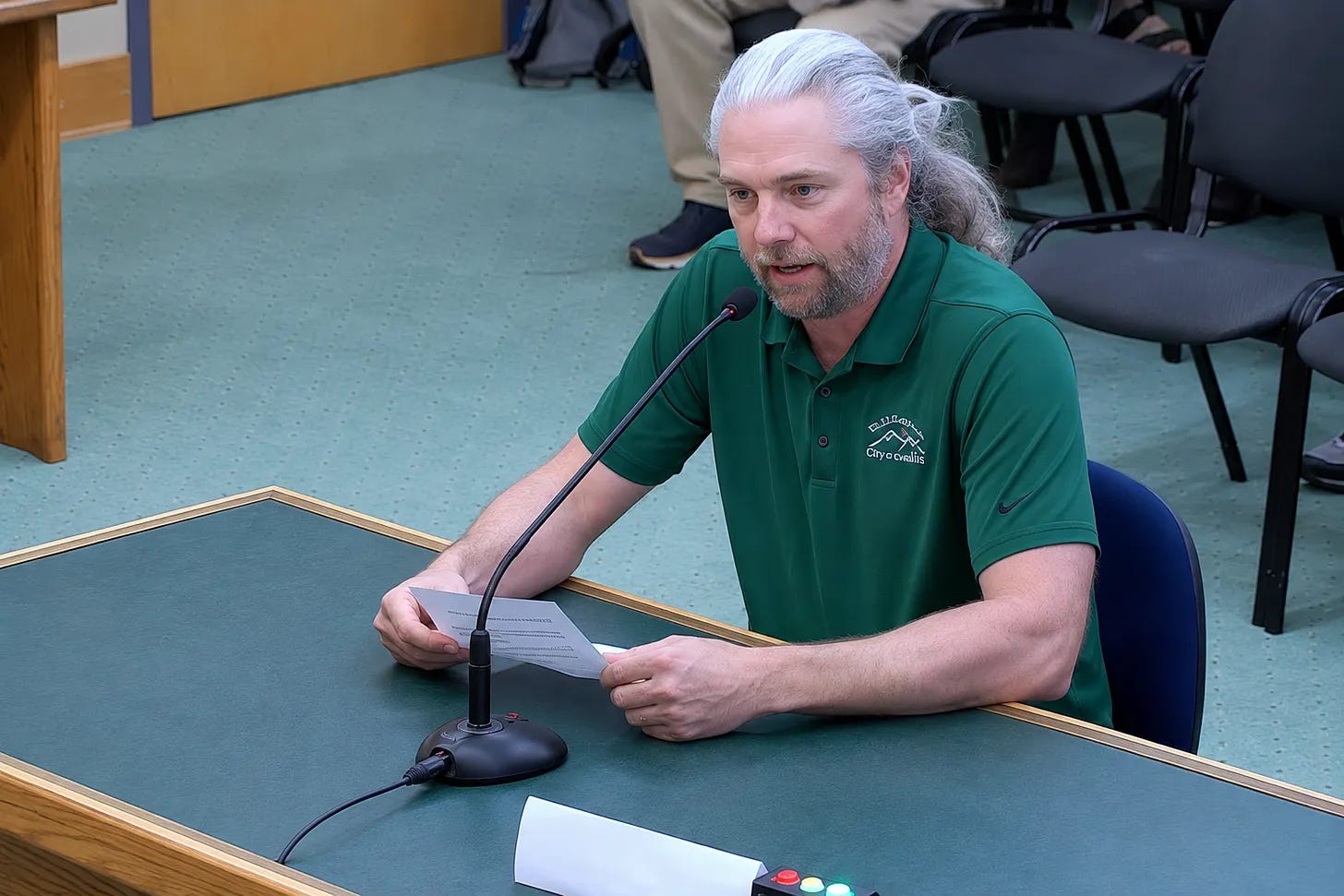
(Photo: Corvallis City Council meeting on August 17)
For residents, those filings will be revealing. Final offers will provide documents showing what each side is actually proposing and how much those proposals are expected to cost.
Once those final offers are made public, Oregon law provides a 30-day cooling-off period. Negotiations can continue during that time, meaning declaring impasse still does not result in an immediate strike.
Once, or if, the cooling-off period ends without an agreement, strike-permitted employees can potentially walk off the job. The union must also provide the Employment Relations Board and the City with at least 10 days’ notice of its intent to strike.
It also should be mentioned that Oregon law treats some categories of public employees differently. Certain public safety employees are prohibited from striking and instead use binding arbitration to resolve bargaining disputes. This means a Local 2975 strike would not cease all City services.
Here is the kicker. The labor dispute negotiations are happening as we face a projected annual budget gap of roughly $8 million. A financial deficit the City has warned could require new revenue, reductions in services, or both.
We highly recommend reading what a “reduction” in services could mean:

New revenue, most likely means the discussed payroll and income tax.
This article was written by Jesse Grant, a contributor to The Corvallis Inquirer. Feel free to send us your stories or articles to publish at: editor@corvallisnow.com
More recent stories:


→ Donate
We’ll still keep it ad-free and paywall-free even if you don’t. 100% of donations go to expanding local reporting, giving back to community causes, and minor operating expenses. Read more about our values and mission here.
Do you have a story for The Inquirer? Email: editor@corvallisnow.com


