

Editor’s note: City officials made it clear that none of those cuts were being adopted during the August 20 work session. The city was not setting its budget or presenting formal recommendations. Instead, the staff was starting to illustrate what reductions might look like as they searched for solutions to a systemic General Fund problem.
It’s possible the city could close some fire stations, reduce library hours by as much as 45%, eliminate some recreation programs, and possibly cut some police services if the city cannot find millions of dollars in new annual revenue.
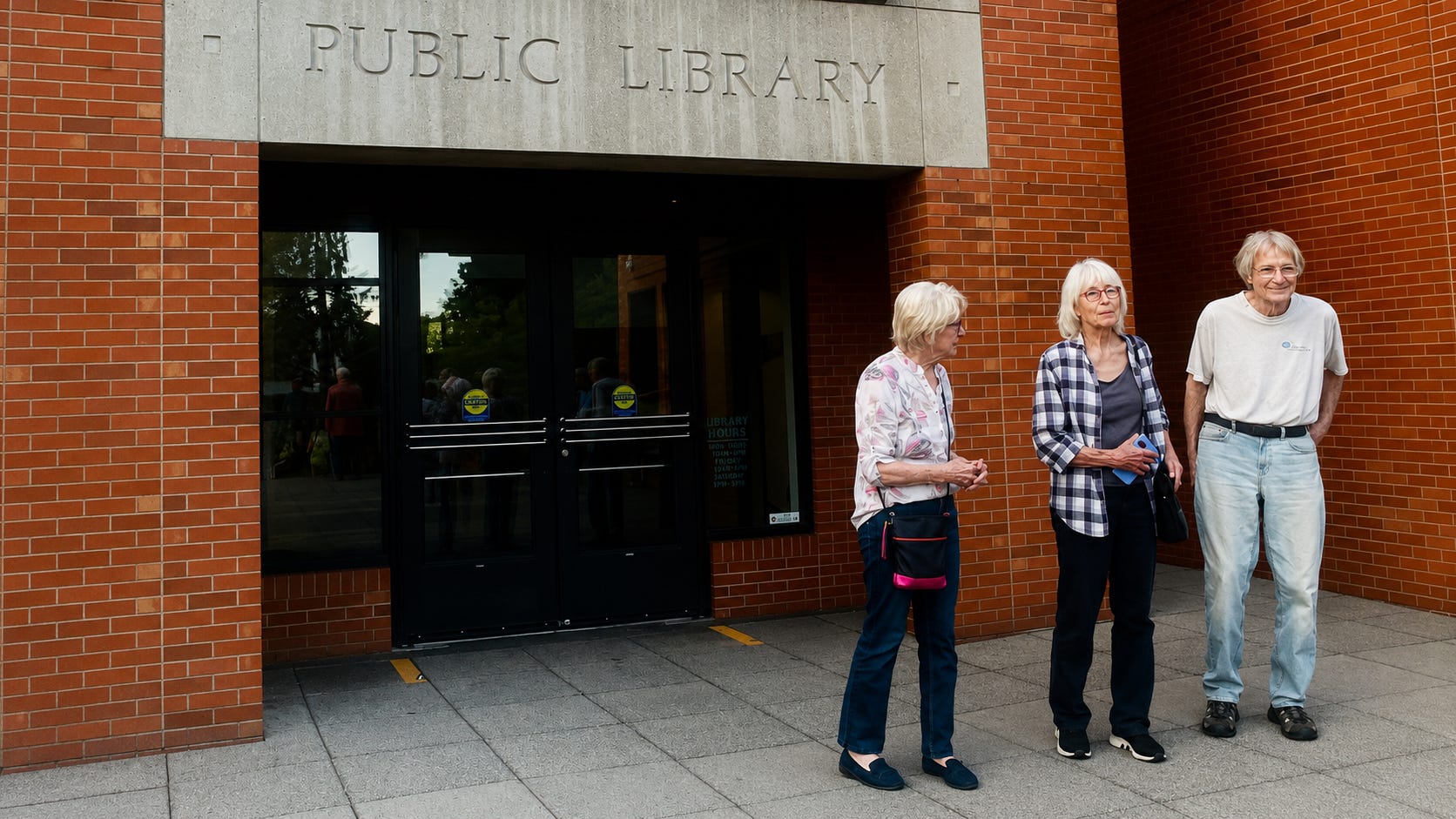
(Photo by The Corvallis Inquirer. Corvallis City Council Candidates Forum, Aug. 12.)
“The city is not setting its budget today,” Finance Director James Inglis said. “We are continuing to do what we started last summer, which is looking for proactive solutions to a systemic problem in our General Fund.”
Several presentations were then provided that Inglis said were not recommendations. He added, “They are to give the magnitude and scope of what reductions would look like if we don’t find a revenue solution to these gaps.”
You may have already heard about one possible revenue solution… personal income and payroll tax.
City Manager Mark Shepard said the presentations show what it would actually mean for Corvallis to operate only with its current revenue. “Sometimes you hear community members say, just live within your means,” Shepard said. “These different service reductions are what it would look like to live within our means.”
Three different scenarios were presented. Each one outlined the impacts of the cost reductions under each scenario.
Scenario A (the most severe cuts) would cut approximately $20.4 million and eliminate about 130 positions. Two fire stations would close, police would shift mainly to responding to emergencies, and more than 60% of library staffing and collection funding would be eliminated. Parks and Recreation would likely be absorbed into another department.
Scenario B (major facility and program closures) would include all Scenario C reductions, plus deeper cuts. Two fire stations would close, the Police Department would lose 20 positions, and the library would be closed on Sundays and Mondays. C3 and the Majestic Theatre would close, while most recreation programs and events would be eliminated.
Scenario C (smaller, but still visible cuts) would close Fire Station 4 and eliminate 10 police positions. The library would close Mondays, reducing its weekly hours from 62 to 40, and offer 65% fewer programs. Park restrooms would close, field use and tournaments would end, and city departments would provide less code enforcement, outreach, and administrative support.
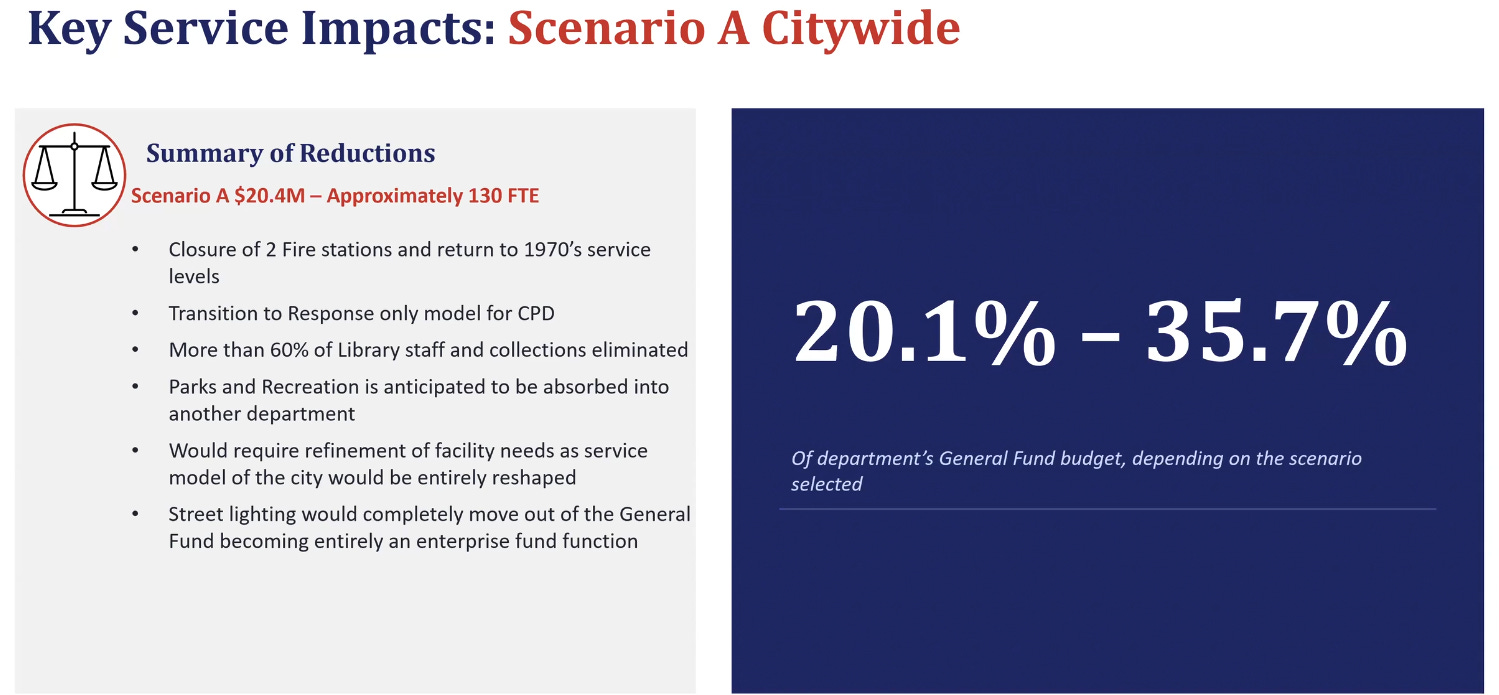
These are all massive cuts. Cuts no one obviously wants to see. Cuts that would make people angry. We can’t see a way “Scenario A” could happen. It is a bit of a scare tactic, and we should circle back to Inglis’ comments, “These are not presentations on recommendations. They are to give the magnitude and scope of what reductions would look like if we don’t find a revenue solution to these gaps.”
Summation: The city needs to find a revenue solution to the gaps.
As councilors discussed the scenarios, Public Works Director Jeff Blaine said they appeared to be moving away from both the full tax package and the deepest service reductions. “What I’m hearing is people coalescing around the idea that they don’t like the idea of 100% new revenues, don’t like the idea of 100% cuts, and want to explore more middle,” Blaine said.
He suggested asking staff to identify $1 million and $2 million in possible savings, which would give the councilors a more manageable way to evaluate the consequences.
Council Vice President Alison Bowden took a firmer position against reductions.
“My goal is still no cuts,” Bowden said. “Zero. Not a thing, because it does get complicated.” Bowden said eliminating an individual service could create additional financial consequences without solving the overall problem.
“I’m not going to be the person who says, ‘Oh, well, we just get rid of this, and everything will be good,’” Bowden said. “Because it won’t be.”
Councilor Jim Moorefield supported public outreach but questioned whether the city should primarily inform residents about its preferred direction or give them a larger role in developing the solution.
“I think the citizens of Corvallis are really used to being more involved in looking at a problem than just being a recipient of a correction,” Moorefield said. “I’m afraid it’ll backfire.”
The city will now prepare an FAQ and other materials explaining the shortfall, facility needs, possible taxes, and consequences of service reductions. Councilors also discussed attending Saturday markets and meeting with residents, major employers, the Corvallis School District, OSU, and other community organizations.
Tax rates, income exemptions, and payroll exemptions have not been decided. The council also has not determined whether a tax would be enacted directly or referred to voters.
For now, city departments will begin identifying what $1 million and $2 million in annual reductions could mean for our city services.
Meanwhile, NuScale, just a few miles from City Hall, is sitting on almost $2 billion…
…HP is sitting on $3.7 billion…
…and unionized city workers are preparing to begin a strike authorization vote for a fairer contract.
Wealth gaps don’t exist only among people. They exist among towns, cities, and the businesses that call them home.
This article was written by Jesse Grant, a contributor to The Corvallis Inquirer. Feel free to send us your stories or articles to publish at: editor@corvallisnow.com
More recent stories:


Do you have a story for The Inquirer? Email: editor@corvallisnow.com


→ Support us
We’ll keep it ad-free even if you don’t.

