

Corvallis Chamber of Commerce’s “Meet the Candidates” forum was held on Friday evening at the Ashbrook Independent School. The event gave residents an opportunity to hear from candidates running for City Council.
It also gave attendees an opportunity to ask questions. We attended. We asked.
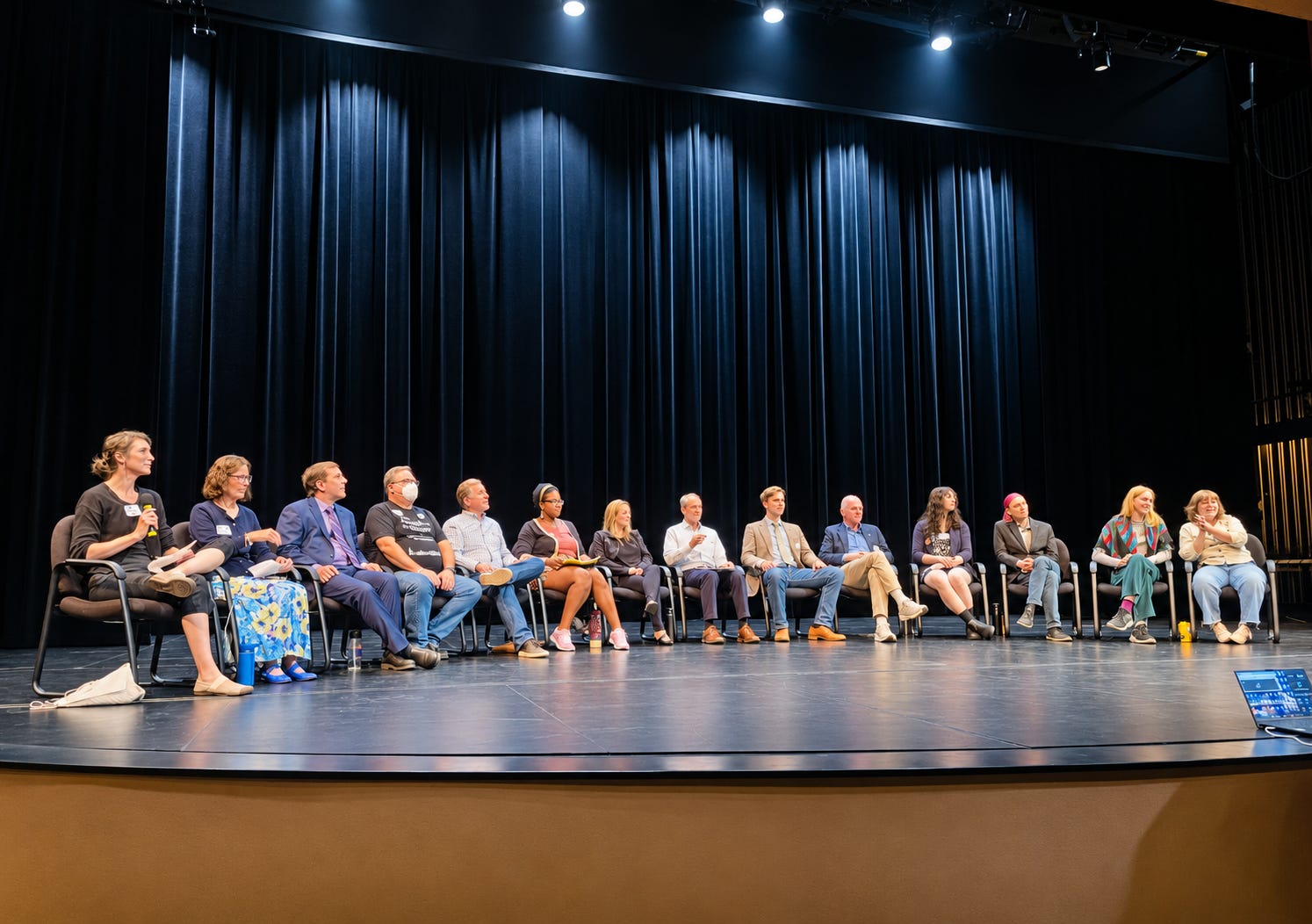
(Photo: Corvallis Chamber of Commerce Candidates Forum/The Corvallis Inquirer)
It was a little ho-hum, in our opinion. Lots of good information was put forth by all the candidates, but much of it was information we already knew, such as their campaign platforms.
Campaign platforms have largely centered on the most important issues: housing affordability, economic development, affordable and accessible childcare, transportation, and environmental sustainability.
With that being said, the largest hurdle the new city council members will face is the budget deficit. If there is no money, then all those important campaign platforms will lack the funding needed to improve in those areas and implement programs to do so.
So, rather than live-transcribe two hours of talk, which we did at the last forum, we decided to change things up and drop a question in the hat at the forum (which was actually a glass jar).
Our question was simple and direct. The budget deficit will be solved through: income/payroll taxes, city service cuts, or a blend of both. Which method do you support?
It’s not our town… it is everyone’s town. Our opinions on the answers to that question matter zero. What matters is your opinion. And your vote. Below is the transcript of the candidates’ answers.
Moderator:
The budget deficit, which we just talked about a lot today, will be solved through income taxes, city service cuts, or a blend of both.
Which method do you support?
Christine Dashiell - Ward 5 - Running Unopposed
I support a blend of both.
I think it would be asking a lot to want people to put this to the voters. I will just say that I’m thinking that would be a good way to go. Regardless, the taxes are going to, yeah, follow the people.
And if we don’t, if the city doesn’t cut back on something, it looks like a really big ask.
And I think, although I’ve been told that the city has really cut everything down to the bone, another candidate mentioned that there are always some cost-saving measures, with some creative thinking and really getting into the weeds.
You can snip them out, and it would just benefit everyone so that the burden doesn’t have to be as great.
Carolyn Mayers - Ward 8 - Running Unopposed
I’ll be the woman of a different kind of an answer this time. I think income taxes and service cuts, and all of that.
I feel like we need to consider this in terms of a package of solutions as opposed to individual parts of the whole.
I feel like combinations, different-looking and different combinations of what can we reduce costs on? How does that affect what level the taxes might be set at?
And what investments do we have to make in economic development and other things to make it so that our long-term physical picture is not going to be looking at another band name down the road, or having to raise taxes or another mechanism?
The bottom line is, if we could grow our tax base, none of this would be necessary. So investing in that, to me, is one of the key components of a long-term solution.
Andrew Struthers - Mayoral Candidate
I think the simple part of the startup was the London option. I would prefer not to see any services cut because I would prefer us to keep Corvallis the way we know it.
But when you’re looking at budgets, sometimes those cuts do come up. If we’re going to be serious about looking at an income tax or payroll tax, we need to look at making it more progressive and making sure it’s not hurting those who have the lowest incomes in our city.
But at the same time, if we’re going to be serious about adding those, what are we doing to make sure Corvallis stays affordable? Does that mean looking at our utility fees and lowering those, and having a balance so that we’re not hitting people who live here more and more?
Is there a way we can balance that so that those who are working here and commuting into Corvallis are helping with that part of the budget?
So I want to see it balanced. I don’t want to see the burden fall entirely on everyone who lives here. So, you know, I start there.
Charles Maughan - Mayoral Candidate
This is an excellent question, which I’ve spent a lot of time on.
I’ve been hosting a series of town halls where I talk about our budget gap and the solutions we’re trying to work toward.
So when we talk about a London solution, we’re talking about budget cuts. Budget cuts mean a reduction of services, and a reduction of services means firing people.
It means people losing their jobs. We are considered a full-service city. The services we provide as a city are what makes Corvallis, Corvallis.
I am not in favor of cutting any services, production of parks programs, library programs, the pool, the Majestic, reducing our fire response times, reduction of police, production in public works.
I’m not in favor of any of that. But the real truth is, a mayor doesn’t have the say-so.
All I’ve got to do is try to speak to the community, explain what we’re working on and the solutions we’re trying to get to.
And the solutions that we have come to over a year’s worth of work, actually longer if you go back to when we first started this conversation, is the payroll and income tax, or one or both, or a combination.
That is what I support, but the solution is long-term. You can address some of the aggressive taxes we’ve heard about and try to reduce those.
A progressive taxation can be escalated for those who can afford to pay the tax and not hurt the Oregon workers who are struggling to pay their rent.
That’s what I support.
I don’t want services cut, but at the end of the day, that is not a decision for the mayor. That’s a decision for the City Council, and I do not envy those who have to make that decision.
Steve Clark - Ward 1
So, for the last year and a half, we’ve been discussing the problems that face Corvallis presently, as a budget shortfall and facility means. We’ve heard a lot about them, and the problems with our city are related to balance measure pride and proper tax limitations.
The problems that we face in this community today actually started about 50 years ago, when the community decided that we were no longer going to be a place of employment. And over the next 30 years, we saw property tax collections on businesses go down, go down, go down, go down.
Now, homes pay approximately 90% of the cost of public services in Corvallis, and business 10%.
I’m not saying charge businesses more. I’m saying have more businesses.
I’m also saying, and I’ve said this to the council in repeated testimony, stop speaking to yourself and start engaging with, listening to, and being informed by the community in collaboration.
That’s what I’ve done over the last three years in an engagement with the downtown strategy vitality task force.
Collaborate with the community, the business community, providing solutions that are long-term.
That’s what I would do.
Now, what we would do in the interim is balance our budget with the current funds we have available. That makes them prioritize the city. Hard to do, but possible, and provide for a community consensus.
If we achieve our consensus around priorities and funding, we may not need a vote. But if we do need a vote because the community can’t concede on what we agreed to, then I will leave it to a vote by the public.
Briae Lewis - Ward 2
You actually brought up what I was going to bring up. The fact that Corvallis was, had, and has been anti-growth for a very long time, until relatively recently.
As a very, very last resort, it would be a combination of both because we really need to look at sustainable alternatives, not just a one-time thing, not just something that’s going to last maybe two or three years, and then we have to do this all over again.
Something that will literally sustain us for about 10, maybe 20 years.
But really look at the combinations of what we can and can’t do with both our current resources and new resources, if we can find them and where we can find them. Really look into the processes of being able to incorporate that for Corvallis to continue being Corvallis.
Tarsa Weikert - Ward 2
As a new candidate, I’m frustrated that this is a question we have to deal with and provide an answer on because I believe it could potentially have been prevented with a little more foresight.
If we get to that point, I would support a mixed blend. However, I would personally like there to be a sunset on this measure that’s going out because I think that if we have an end date temporarily, then more people will vote for it.
And then, while they are getting more funding from these measures, we could theoretically solve our other issues, which means figuring out what inefficiencies are going on in Corvallis while also promoting economic growth.
And then, theoretically, over a period of time, we would no longer have to have this tax, and we would have our issues solved.
Paul Berg - Ward 4
I’m also in favor of a blend.
I think the trust that the government can make are small, and most of that shortfall is going to be, must be met with additional taxes, payroll and incometax.
And those can be made progressive.
So I think that’s where we’re going to have to go. Like Steve mentioned, long-term, we need to promote business. We need to, more closely, work with Oregon State and try to leverage the good ideas coming out of OSU to develop more businesses in the community.
But in near term, I think we’ve got to be faced with the payroll and income tax.
Brennan Colberg - Ward 6
In the near near term, I don’t think payroll and income taxes can be implemented fast enough to plug our hole.
So it’s going to be some combination of looking at reserves, cuts, because people like talking about cuts without being specific.
If I were to cut something, I would look at our social services. We have a whole ton of publicists, and it is continually growing.
You get what you incentivize, we are incentivizing it quite a bit, and that costs us money and causes problems.
Payroll and income taxes seem like a sustainable medium- to long-term solution.
I’d be interested in a flat, non-expiring payroll or income tax because our current system, long-term, is to occasionally hike service fees, which is an extremely aggressive policy.
So we’ve been going to a flat tax is something that I think would be more acceptable and is far more aggressive than our current system.
I’d be open to enacting that via ordinance, and if the community really dislikes it, then you’ll have a vote on it on either way.
I’m also open to funding economic development via income tax.
Jerry Ingersoll - Ward 7
In the long term, growing the pie is clearly a solution.
And providing opportunities for business development for housing development is going to balance the books over the long term.
In the medium term, we cannot sustain a cost at the same level of service that rises faster than the rate of inflation or that rises faster than the rate of wealth in the community.
We have got to have cost controls.
If we can control our rising costs so that they are in keeping with regular inflation, I think, at that point, voters could be brought to support a payroll or income tax.
I would not be in favor of the council enacting those by ordinance. I think it would need to come back to voters.
And if it gets to that point, then I would support a progressive income tax, and the payroll tax.
Danielle Chambers - Ward 7
I’m going to be saying a lot of the same and a little bit more.
I would also support a progressive income and payroll tax, or some combination there of, because when we fire people, getting people back and the drop in service quality, or even cutting altogether in the meantime, is going to be disastrous. Having to rebuild those things is a waste of resources at the time.
I would also like to say that moving to a more progressive tax structure can be a wonderful boon for our economy.
A progressive tax can meaningfully influence what’s called the velocity of money. You can picture dollar bills sort of like blood cells.
We want them to be flowing that fast in between places.
And when we tax progressively rather than regressively, like with a flat tax, like the city services fees, these currently, whichever pays the same amount on.
When we tax people more in line with their income, we increase the velocity of money in our community, and our little businesses benefit as the spending gets recycled.
Kasey Haxton - Mayoral Candidate
I’ll try to be as short as I can, no promises.
So generally, I think what I’m recalling in my platform is going to require extra revenue, no matter what, so there will need to be some increased taxes.
I mean, it’s very clear, tax the rich, I do not favor, in any way, shape or form, taxing people who are low- and middle-income, which makes sense.
I’ll say about a payroll tax, I don’t favor a payroll tax of any kind at all. You end up taxing people who work here and don’t live here.
This is what Salem did, actually, in 2023, and it was overturned by their electorate by more than 80%.
It’s like an awful collection. So if you try to pass a payroll tax, good luck. I will not be voting for it.
An income tax, though, if it’s progressive, is the one that I would favor, like Multnomah County. It starts at $125,000 and up. So you’re taxed $0 on your first $125,000.
That’s the kind of progressive income tax that I would favor. I don’t think we can grow our way out of this. Growth is a Bowsky market.
When you add more tax base, you also add more services.
The only reason why this makes any sense is that, in the short term, these services don’t cost as much as they do in the long term.
So when you grow your tax base as a way to close a budget gap, you’re actually hurting the future generation, and it gets worse as time goes on.
As people, you know, when you put people into your city, they can grow the city, they need electricity, they need water. These are all the services that we pay for.
So growth is not a way out of this budget gap. I think it’ll actually make the problem worse.
Evrek Smith - Ward 4
I agree with a lot of these concepts, so I’ll try to keep it brief.
The city services are services that people use, that people rely on, that people benefit from.
I fully support progressively fixing the way our city’s income is made. Progressive taxation has been talked a lot about, and I support that.
I think growth very necessary. Absolutely a key part to solving our structural issue.
But I think we don’t need to be slashing things people rely on, cutting jobs, cutting services, cutting the things that make Corvallis, Corvallis.
Bre Irish - Ward 1
I would also agree with what has been on regards to the services for people. I think there are so many people who rely on that.
They are what keep this city moving. It takes water to our homes, electricity in a lot of cases, roads, et cetera.
And I also think the point of a government existing is to support people.
At a time when Americans and Oregonians are increasingly facing higher and higher costs as well, this is the last time to multiply that cruelty on them from our economy by provoking social services. And especially if somebody has lived experience with homelessness as well. It’s not something that we want to continue.
And so it’s not as it was phrased here onstage. I think we need to continue supporting our people.
Editor’s note: Asa Jorg running in Ward 7, was not in attendance. Kimi Gatherum, running for mayor, was not in attendance. Greg Shiffer running in Ward 6, was not in attendance. Things come up, but usually a candidate who wants to win a race for City Council, who holds the passion to take part in the City Council, and who will show up to City Council meetings… would likely attend the candidates’ forum hosted by the Chamber of Commerce. That’s our opinion at least.
This article was written by Brian Lindensmith, a contributor to The Corvallis Inquirer. Feel free to send us your stories to publish at: editor@corvallisnow.com
→ Donate
We’ll still keep it ad-free and paywall-free even if you don’t. 100% of donations go to expanding local reporting, giving back to community causes, and minor operating expenses. Read more about our values and mission here.

Do you have a story for The Inquirer? Email: editor@corvallisnow.com



Well yes, no money. But you can bet they will find money for the Britalist Glass Cube the want to build where the current City Hall sits. The City Manager, with his 6 figure salary DEMANDS a space suitable for his vast desk. We must spend large MILLIONS to make him happy, to hell with those pesky homeless people, maybe the Mayor, city council, and the All Powerful City Manager will buy them all one way tickets to Portland, let our homeless problem be Portland's homeless problem. Yes, you read that correctly, screw the homeless, street repairs, what have you, WE MUST HAVE A BRUTALIST GLASS CUBE to keep up with other cities.