

What dominates media headlines these days when it comes to social or political issues? Data centers, affordable housing, healthcare accessibility and affordability, immigration, education, etc.
All of these are probably most of the main, important underlying issues currently at hand in our city, in the state, and in the country. While the big picture is usually the most important, sometimes the small picture needs to be fixed first.
This part took some time. So, if you’re still reading, thank you. The League of Women Voters of Corvallis has a link, a link with 19 videos of Corvallis City Council candidates. You can find it here.
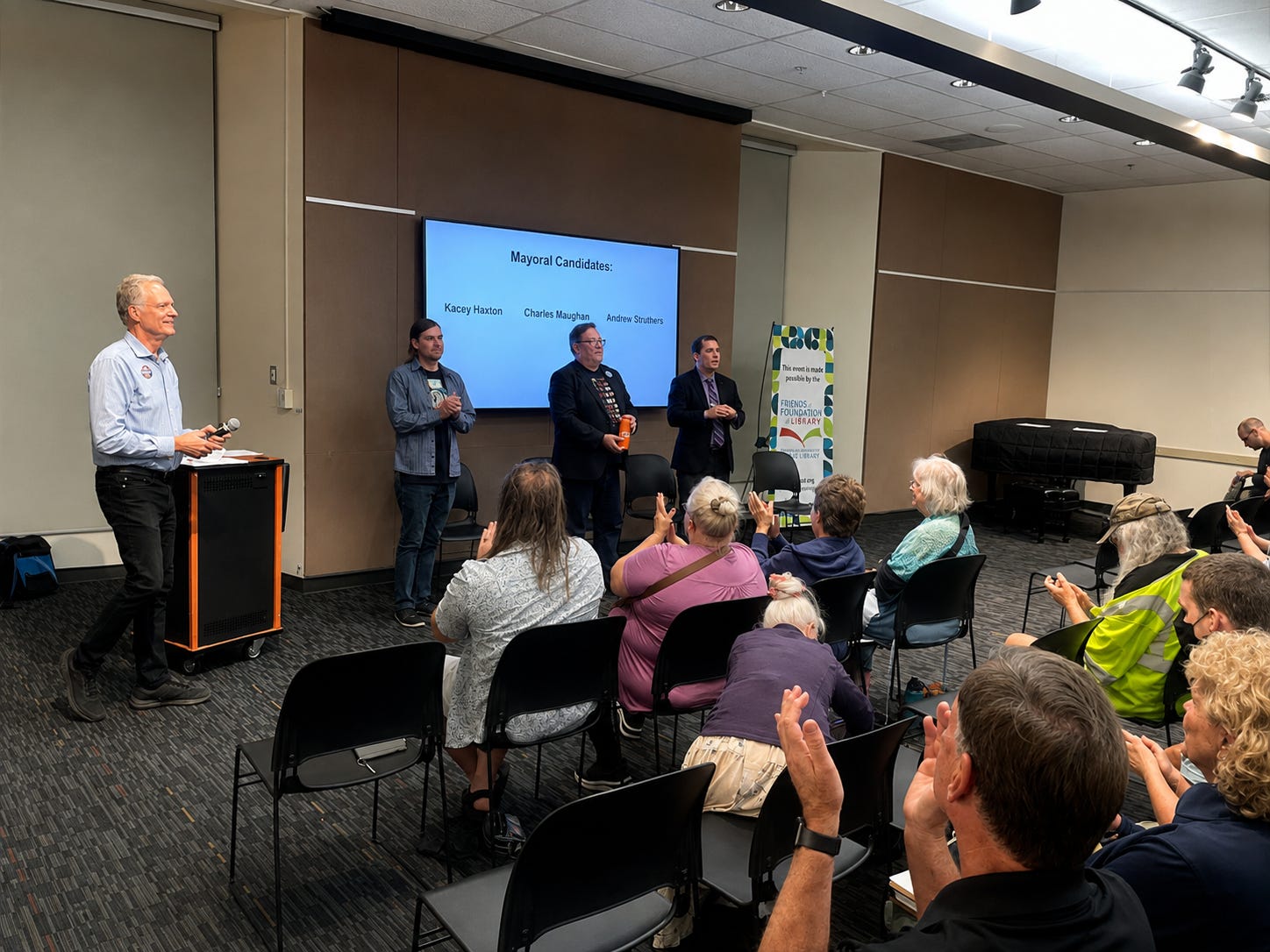
(Photo: Corvallis City Council Candidates Forum/The Corvallis Inquirer/August 12, 2026)
If you go through each and every video, transcribe them, and take the total verbiage and topics discussed, 11.6% of the total candidate speaking time was devoted to the City’s budget deficit problem. This data is marginally skewed by the questions asked, but the budget deficit could have easily played a part in every answer.
We’re not stupid, and you’re not stupid. Populist vote farming is a thing. It’s when a candidate aligns their policies with the perceived desires and anxieties of the majority of the public. It is something to be aware of. It is a tactic to gain the most votes in order to win. It plays a part in most elections.
So, of course, a lot of candidates, not just those running in our City Council campaigns, are going to use these practices. Yes, our candidates do support the main underlying issues at hand, believe in them, and will fight for them. They are not simply farming votes through populist opinion.
But 11.6% says something. It says the candidates do shy away from the most important immediate issue at hand for us as a city, as a microclimate of our lives, what will affect the majority of us the most, in terms of our town… and that is the budget deficit.
Income taxes may need to be implemented in order to cover it. Those will affect you. Cuts to important parts of our social structure may need to be made to cover it. Those will affect you. Decisions on new city infrastructure may need to be made in order to keep the deficit in line. Those will affect you as well.
Just 11.6% of total candidate speaking time was devoted to the City’s budget problem. And that’s a problem in itself.
Let’s reiterate it: the social and political issues that dominate media headlines are important to us. And, in all fairness, it’s great that new candidates are speaking about those things. But if we don’t solve the main microeconomic issues at hand, then we won’t have the resources, monetarily and politically, to work on those larger macro issues.
New candidates need to speak up more about their takes on the budget deficit, because our current City Council has taken note.
At the meeting on September 22, they made it clear that these issues are not entirely theirs to decide, but will also fall to the next Council, its new members, and the changes that come with them.
While the candidates aren’t spending a huge portion of their time talking about it, people currently on the council are. They spent a considerable amount of time Tuesday night talking about it. And for good reason.
Councilor Tony Cadena argued that the City needs to be clear about that uncertainty, particularly with so much discussion already circulating in the community.
“There’s a lot of discussion and commentary in the community and on social media, which I think is generating a lot of confusion and unnecessary angst,” Cadena said, emphasizing that the Council had reached no final decision.
And Cadena was among those looking toward the Council that will take office after this election.
“I think we should just continue to discuss this further about what we can do and hand off the best possible plan,” Cadena said, including decisions about how the City addresses the budget gap.
Not everyone was comfortable drawing a line around what the current Council should or shouldn’t decide. Councilor Charlyn Ellis objected to language suggesting the current Council would categorically leave the decision to its successors.
Councilor Jan Napack also resisted shutting the door on action by the current Council. Her concern was that postponement could mean spending substantial time bringing a new group of councilors up to speed on years of work already done.
“It’s going to take another two years for us to educate the community and the new councilors to revisit all that was done in the past three to four years about facilities,” Napack said.
And that brings this right back to those candidate videos and the transcripts we analyzed. Because this is not a problem the next council will get to discuss. It is a problem they will inherit.
Whoever occupies those seats will be confronted with versions of the same choices now sitting before the current council: raise additional revenue, reduce services, reconsider the scale or timing of facility investments, or construct some combination of all three.
The current council has already spent months studying those choices. The City has evaluated more than two dozen revenue possibilities, examined substantial service-reduction scenarios, and narrowed its current revenue work to income and payroll taxes.
When it comes to voting, the next city council doesn’t get to start with a blank sheet of paper. It gets the bill. That 11.6% doesn’t tell us whether candidates understand the problem. It doesn’t tell us whether they know how to solve the problem, understand the finances and balance sheets, or know what will ultimately be best for the community.
Affordable housing matters. Homelessness matters. Transportation matters. Climate policy matters. Public safety matters. All of those larger conversations matter. But the financial implications of the budget also matter. And it’s a timely matter… the deficit, and the decisions ahead of current and future city council members.
Before you cast your vote, know that these are decisions we make ourselves at the ballot box, to be made by the people we elect to represent us.
We listed some of the important issues competing for center stage, as they should. But in our opinion, the budget deficit should be in the main spotlight. Our candidates should be there, answering questions about the financial implications of some of the most significant decisions we have ever faced.
Have they looked at the publicly available balance sheets? Do they have the auditing skills needed to make an informed decision? Are they making decisions based on their education and understanding of the variables in those balance sheets? Are their decisions being made to accommodate campaign promises?
It’s easy to avoid. And not taking a side, or not having a firm opinion on the deficit, might not lose you votes. And you don’t want to lose votes in an election. Either way, there are decisions you’re going to have to make. Once elected.
Just let us know how you feel about it now. While we still have a voice.
This article was written by Jesse Grant, a contributor to The Corvallis Inquirer. Feel free to send us your stories or articles to publish at: editor@corvallisnow.com
More recent stories:


→ Donate
We’ll still keep it ad-free and paywall-free even if you don’t. 100% of donations go to expanding local reporting, giving back to community causes, and minor operating expenses. Read more about our values and mission here.

Do you have a story for The Inquirer? Email: editor@corvallisnow.com


