

Editors note: a neutral take on the recall
A growing political fight over school closures in Corvallis is now raising a bigger question for the community: would recalling the entire school board actually improve the situation… or deepen the district’s turmoil?
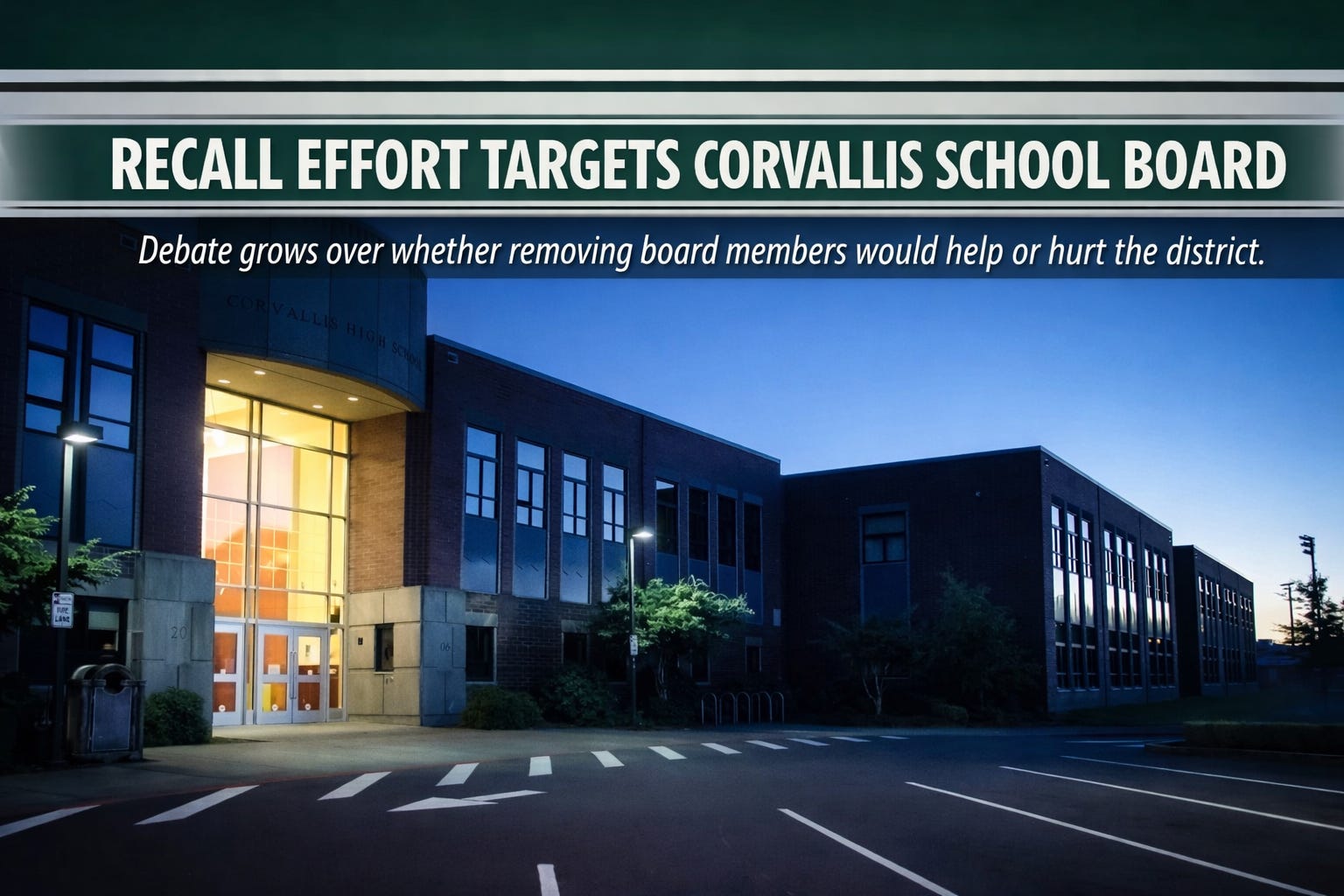
A local parent coalition called Save Corvallis Schools is circulating petitions to recall all seven members of the district’s elected board. If enough signatures are gathered, voters could decide the fate of the board in a special election later this year.
Why the Recall Effort Started
The recall campaign began after the district announced plans to close schools as enrollment declines and financial pressures grow.

Parents involved with Save Corvallis Schools say they are concerned about transparency, communication, and several recent decisions made by the board.
Issues cited by recall organizers include:
The planned closures of Letitia Carson Elementary School and Cheldelin Middle School
Concerns about communication between the district and families
Budget decisions and district leadership priorities
Changes to curriculum and district programs
To qualify for the ballot, each recall petition must gather at least 4,577 valid signatures from district voters.
The School Board Members
The seven-member board elected by voters oversees policy, approves the district budget, and hires and evaluates the superintendent.
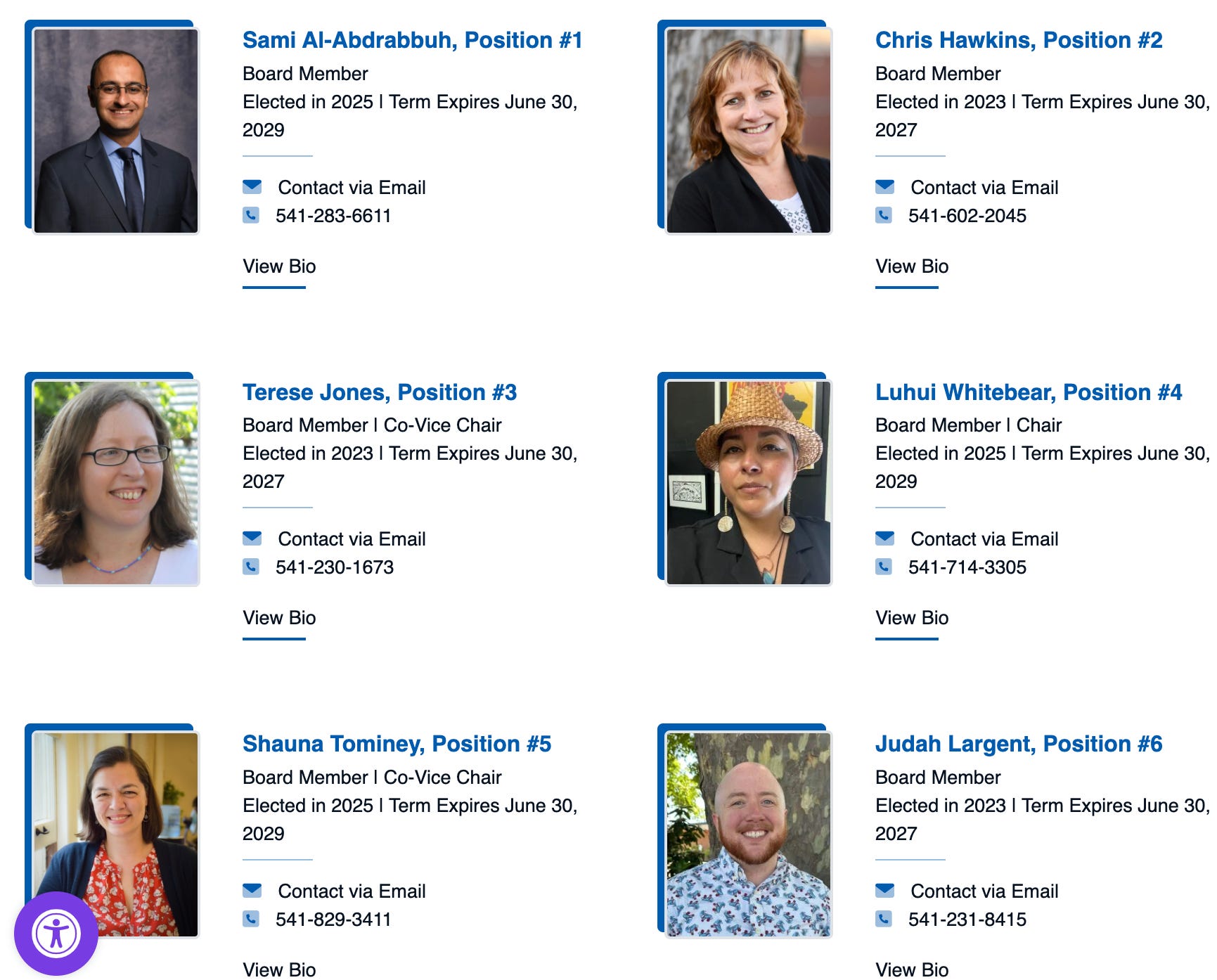
Many of the board members have extensive academic or professional backgrounds connected to education, research, and public policy.
School board members can be compensated for their positions of up to $500 a month per Oregon law. It is not a full-time, salary-based position, like other elected officials.
This is important:
Collectively, the seven members of the Corvallis School Board hold at least three doctoral degrees, four master’s degrees, and seven bachelor’s degrees.
Several members have careers rooted in research, education, and public policy.
Dr. Shauna Tominey, has published research on child development and social-emotional learning and previously worked with the Yale Center for Emotional Intelligence. She holds a PhD in Human Development and Family Sciences from Oregon State University
Board Chair Luhui Whitebear has experience in education leadership and serves on the board of the Oregon School Boards Association.
Sami Al-Abdrabbuh holds a Doctor of Philosophy (Ph.D.) in industrial engineering with a focus on Human Systems Engineering.
Terese Jones is a doctoral student in Human Development and Family Sciences, Oregon State University
Berni Wang holds a Juris Doctor University of the Pacific, McGeorge School of Law; MA National Security Affairs and Strategic Studies, Naval War College; BA Political Science, University of Washington.
It’s a mouthful. Supporters argue that this level of academic and professional expertise is particularly valuable as the district navigates complex challenges like declining enrollment, budgeting, and long-term facilities planning.
Critics say these qualifications do not necessarily mean these are the right people for the job, and the current and past issues back this ideology up.
The Cost of a Recall
A recall election would also come with a price tag. In an email response to questions, Superintendent Ryan Noss said the district would be responsible for covering election costs.
“The district typically budgets $30,000 for a shared ballot, which includes other jurisdictions. In this instance, the costs would be higher because other jurisdictions would not have an election on the ballot.”
In other words, a recall election held on its own ballot could cost significantly more than the district normally spends on elections. Critics of the recall argue that those funds could otherwise go toward classrooms, teachers, or student services.
Potential Benefits and Drawbacks of a Recall
Supporters of the recall campaign argue that a leadership change could:
Force greater transparency from district leadership
Rebuild trust with parents and the community
Slow or reconsider school closures
Bring new perspectives onto the board
Some residents say the recall effort has already succeeded in one way: it has forced more community attention onto district decisions.
Others warn that recalling the entire board could create instability at a time when the district is already navigating declining enrollment and budget shortfalls.
Potential risks include:
Leadership vacuum: replacing seven board members simultaneously could slow decision-making.
Delayed budgeting: the board must approve budgets and oversee major district operations.
Uncertainty during school closures: new members would inherit complex financial and facilities decisions already underway.
Community Reaction
Reaction among residents has been mixed. Some parents posting in local forums say they feel the district hasn’t listened to community concerns about school closures.
Others say the recall effort risks turning school governance into a political battleground that could make it harder to focus on students.
Several commenters say they support greater transparency but remain unsure whether replacing the entire board would actually change the district’s financial reality.
What Happens Next
If recall organizers collect enough verified signatures by early April, the effort could move forward to a special election where voters would decide whether each board member should remain in office.
Would replacing the school board fix the district’s problems? Or simply create new ones?
— The Corvallis Inquirer, March 15, 2026

Do you have a story for The Inquirer? Email: editor@corvallisnow.com

→ Support us
We’ll keep it ad-free even if you don’t.

