

This is just for the mayoral portion of the Corvallis City Council Candidate Forum. If you missed the live transcription to the website for the Corvallis City Council candidates, you can read it here:

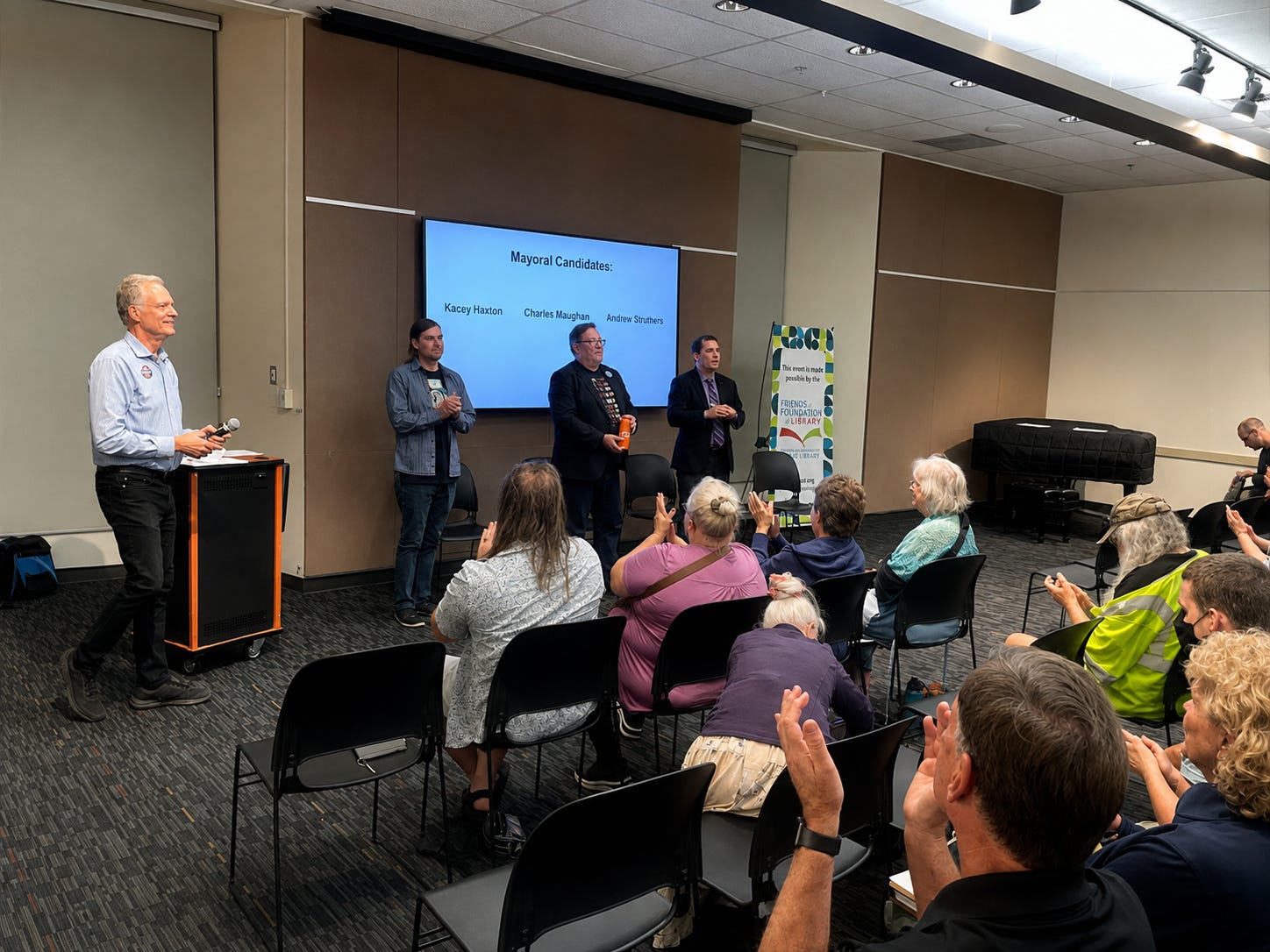
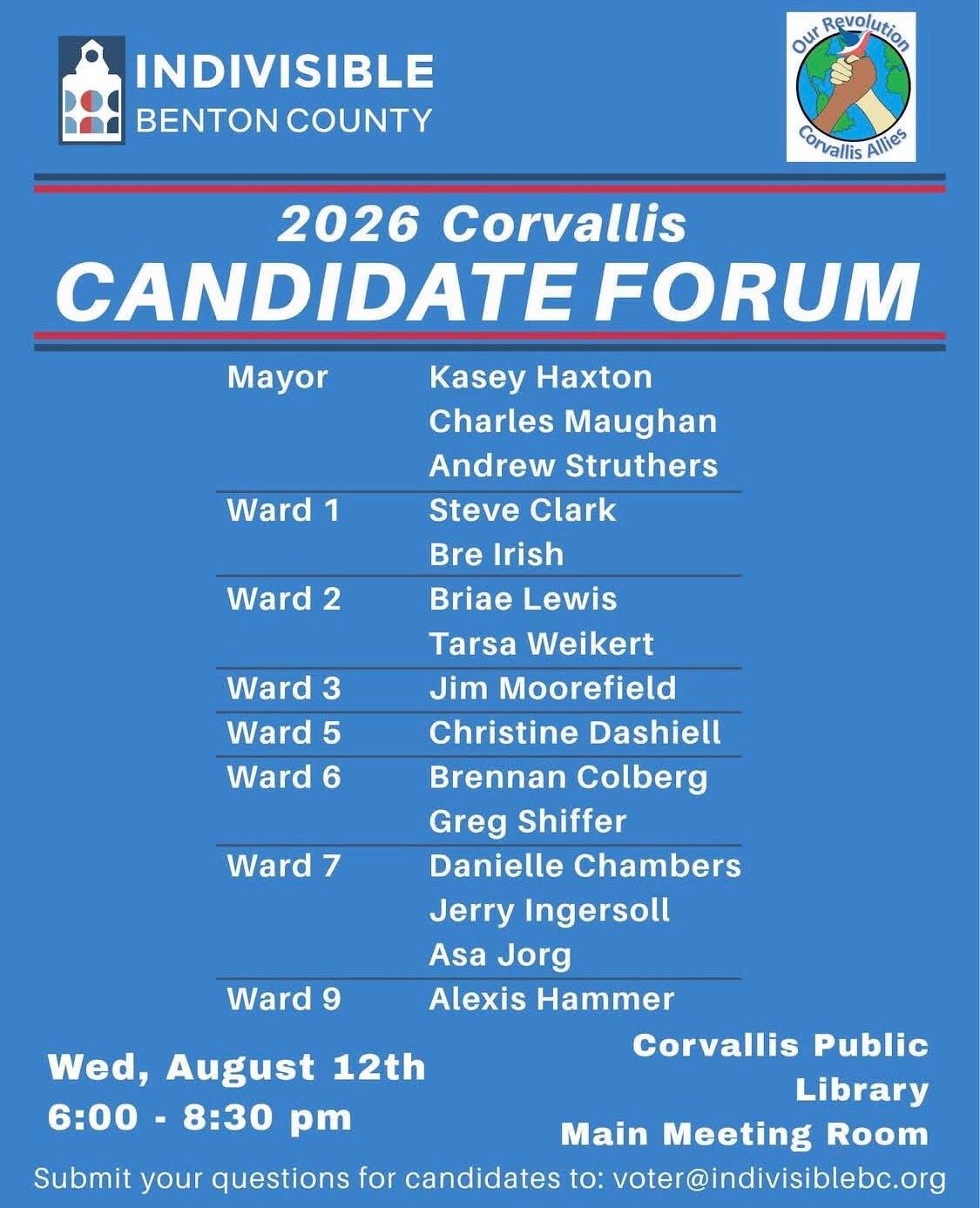
Moderator
We’re about to run this just as we did before.
I’d like a statement from each candidate — their general philosophy — and then I will ask some questions. We’ll also handle questions from the audience.
Let me start with Kasey.
Would you give us a sense of your background and philosophy?
Kasey Haxton — Opening Statement
Thank you.
Hope you don’t mind, I’m going to keep my own time here.
My name is Kasey Haxton.
I am 37 years old. I was born and raised in Florida.
I hope you won’t hold that against me. I didn’t have a choice in the matter.
My parents were very working class. My mom was a waitress and a teacher. My dad was a truck driver and a construction worker.
In the crash of 2008, he lost his job and his home, and I was laid off twice.
I was also a construction worker at the time, just starting my career at the young age of 18.
So, I joined the Army in 2008. I was a helicopter mechanic for two years.
I moved to Oregon in 2010 after I was discharged under honorable conditions.
I moved to Corvallis a little bit after that.
I love the culture here and, just like everyone else, I want to spend the rest of my life here.
I want to raise a family here, truly.
But like so many others have said, I’m not sure that I can afford it, and that is the only thing that would force me out of this town.
So, I’m running on the platform that housing is a human right, and unfortunately, it’s just not respected in this city.
And what that means is that we give everyone a home.
When I first moved to Oregon, I had no connections. Not long after I moved here — probably about six or eight months — I became homeless in Ashland, Oregon.
And I was told immediately that I was unwelcome in town.
The very first night I slept in my SUV, I was woken by a cop, and they said not that I was committing a crime or that they were going to arrest me, but that I was not welcome in town, that there was a city limit, and on the other side of that border, I wouldn’t be their problem anymore.
Two years later, in Ashland, I was able to co-found a nonprofit called Options for Homeless Residents of Ashland, which is now the largest shelter provider in the area.
Just as important as helping people who are struggling with homelessness, as I did, is housing affordability.
I didn’t become homeless personally because I had a mental disability or because I had a drug addiction.
I became homeless because I couldn’t afford the rent.
That’s all it takes.
In Corvallis, we are the most renter-heavy city in the state. Sixty percent of households here are renters, and 60% of those renters are burdened by the cost of rent.
That means more than a third of their total income goes to rent. It’s the highest in the state for both.
Since 2019, when both of my opponents here were councilors, the average rent across the board, all types of housing, has increased 63%.
Sixty-three percent since 2019.
Since 2023, it has increased 23%.
We don’t have numbers for homelessness in the city of Corvallis, but Corvallis is about 65% of Benton County, and we do have those numbers for Benton County.
Homelessness has increased 58% in Benton County since 2023, and unsheltered homelessness 74%.
It’s almost doubled.
I believe that our current approach to housing affordability is not working.
We’re basically just subsidizing private development and asking them, “Please, pretty please, keep some of that affordable, won’t you please?”
And it doesn’t actually work.
There’s really no accountability.
If it was working for the last 10 years, housing prices wouldn’t have increased so much, right?
But it hasn’t worked.
This is the same approach that the current mayor has been using for the last eight years — actually since 2016, when his first campaign was unsuccessful.
Same approach.
And right now, they’re running on more of the same.
I believe that the new approach we need is called municipal housing — public housing.
It’s a very, very old concept.
It’s ancient.
Right now, if we built 10,000 more housing units in Corvallis, it wouldn’t necessarily lower the price of housing at all in Corvallis.
Development is not the problem here.
We don’t have a housing supply shortage.
There are over 1,200 vacant homes in Corvallis right now and far fewer people without homes.
It’s a distribution problem.
It’s a lack of affordability, and the city hasn’t really done what it takes to get that affordability.
So, skipping through here real fast, we don’t have to wait.
We can tax the rich now.
That’s how we’re going to pay for this.
Tax the rich.
Yes, property taxes are limited, but service fees are not.
There’s no reason why service fees couldn’t be lowered for the 99% and increased for the 1%.
So, tax the rich.
I have a background of doing this.
Right now, we have the most regressive tax system that I’ve ever seen for any city in the state.
I’ve never seen a city with as much dependence on fees.
It’s more than property taxes.
Property taxes are limited, but these aren’t.
Anyway, we also need to update our infrastructure and make sure it’s green, safe, and efficient.
Zero traffic deaths.
I do believe that we need subsidized childcare to make it truly affordable.
We want to make Corvallis family-friendly.
I also want to ban gas-powered leaf blowers citywide.
Portland did that earlier this year.
I also want to take a stand against data centers, and I’m also against the TIF and the income tax proposed.
I’m not opposed to progressive taxes, but that doesn’t sound like what’s on the table.
Thank you very much.
Moderator
Thank you.
I’d like to call Mayor Maughan.
And I’d like to remind everyone: We should not be attacking other candidates.
This is just a presentation of your philosophy and direction.
Mayor Charles Maughan — Opening Statement
I want to start off, as many others did, and just thank everybody for being here.
It always impresses me when people turn out like this because, one, I get to see so many familiar faces, and it just makes me really happy to see people so engaged in our community.
I went back and forth on what I should talk about.
Some people talked about their history, how they came to Corvallis.
I’ve told that story many times.
I’ve talked about growing up in poverty, raising kids in poverty, and struggling to put food on the table.
I’m going to skip that today.
Instead, I’m going to jump right into why I’m running for reelection.
To do that, I need to go back to when I first had a successful campaign and started serving on the City Council.
We had a lot of campaign promises.
And while you’re in the middle of it, because things move so slowly, it’s hard to tell whether you’re really making progress.
One of my main goals back then was to move the city to 100% renewable energy to address climate change.
Although not 100% successful, I moved the needle on that.
We installed solar.
We changed the police vehicles to hybrids.
We moved our city fleet to electric, and we started the process to purchase electric buses.
I want to continue that work.
At that time, I also had a strong focus on affordable housing.
It’s always been the main staple of my campaign and will continue to be so until it’s no longer needed.
I don’t see that future happening soon.
As a city councilor, I pushed the city to start addressing affordable housing, to look at our code and make improvements, to find ways to develop the housing we need.
I made the motion to rezone some light industrial land to high-density residential.
Those motions and those changes have turned into hundreds of units of affordable housing that we have today.
It takes time.
As mayor, I’ve continued pushing on these items and more.
I want to continue investing in our city’s infrastructure so we can continue to provide the services that you all rely on.
You can’t do it if you don’t have a place to do it.
We’ve had success on that.
We have remodeled two fire stations to be more equitable.
We now have female firefighters and nonbinary people, and it doesn’t work with the old way we used to build fire stations.
So, we remodeled them.
And not only does it improve the quality of life of those firefighters, they get better rest and they’re better ready to respond to emergencies.
Those fire stations both have solar.
They protect our equipment, which saves us money, and addresses climate change because we’re not buying new equipment every few years.
We just recently broke ground on the new Parks maintenance facility.
The old facility was in a floodplain.
Our equipment was getting damaged faster than it needed to be.
We were replacing equipment all the time, and people were working in a substandard location.
With this new facility, again, we can address solar.
We can provide better working conditions for our Parks employees and protect the equipment so we get more out of it.
That’s just good governance.
I still continue to focus on affordable housing, and I’ve made major progress in that area.
Anybody who looks around sees construction happening. You might wonder what some of that is.
We currently have — what was the number? — I think something like 1,900 applications for housing throughout all of Corvallis, all housing types.
Single-family homes, cottage clusters, memory care facilities.
We need all types of housing.
Of that, though, we also developed more than 400 units of affordable housing.
Most of that — and I’ll get into my game style, because I work at a four-pile — was at 60% AMI, which used to be considered pretty low income.
Now it’s actually kind of working-class income.
We need that too.
The City of Corvallis took our funds and used them smartly.
We worked with those developers to have a certain amount of units set aside at 30%.
That’s extremely low income.
That’s where people are stuck on single incomes like Social Security or Social Security Disability.
We need that housing.
That’s what gets the chronically homeless, the people who are most endangered in our community, into stable housing.
As we heard earlier, we also have 47 units of permanent supportive housing.
That’s housing that’s affordable.
It has wraparound services that stabilize people to keep them in their homes.
That’s moving forward.
The city also recently — this is something a lot of people don’t know — purchased two properties.
One of them will be permanent supportive housing. The other one will be transitional housing.
Both of those are currently being remodeled, and we worked with the county to provide services because they have the funds and the healthcare people to operate something like that.
The city does not.
But we can put money into infrastructure.
We can fund the needed services and get somebody who are experts in it, like the county, to run it.
I’ve worked on building relationships with OSU, the county, and our state.
We recently needed money for a 911 center.
I reached out to our congresswoman about it.
She has $1.5 million to go toward that backup 911 center.
We needed that.
And we’re not done.
The city is at an interesting time where we have some of the biggest challenges facing Corvallis that it’s maybe ever seen.
It’s also an exciting time.
Because we can fix these issues.
I want to correct something I said earlier.
You said that we have an unbalanced budget.
Not true.
Our budget is perfectly balanced.
It is functional, and it is weighed out regularly with the council.
What we have is a gap for the next budget.
That was identified because the cost to operate the city goes up all the time.
And surprisingly, when you have contract negotiations with unions, they ask for a larger COLA.
We like to take care of our employees.
It creates challenges.
So, what we’re trying to fix is how to fund the services as they are, because the only other option is to cut services.
But we will have a balanced budget.
Thank you.
Moderator
Thank you very much.
Andrew?
Andrew Struthers — Opening Statement
Well, thank you, everyone, for being here tonight and sticking it out tonight.
I know it’s getting late.
As mentioned, my name is Andrew Struthers, and I’m running for mayor here in Corvallis.
Some background on myself:
I did serve on the City Council from 2019 until 2022, and I did run for mayor in the last election.
And surprisingly, I only lost by 34 votes in a community our size.
I currently work at Oregon State University.
I support the Division of Student Affairs as an IT consultant within our IT department, which is the Student Affairs IT team.
I’ve been working at the university for 14 years.
I’m an active member within my union.
I am a member leader there.
The union is SEIU 503.
Prior to working at the university, I went to school at Oregon State University, and I earned two bachelor’s degrees there.
I was born and raised in Albany, in the Linn County area.
So, I’m a local to the Willamette Valley.
I’ve been here all my life.
Myself and my wife are raising our 9-year-old daughter and our 4-year-old son here in Corvallis, and we love it here.
After I left the council, I was looking for ways to stay involved in our community.
I was asked to serve on our Benton County Planning Commission, and that’s what I’ve been doing since 2023.
And then I’ve been coaching Little League softball.
So, I’m a softball coach now in our community.
So, why am I running?
Over the last few years, I’ve been staying engaged and talking with parents, workers, businesses — anyone who just wants to be listened to.
They talk about the great things about Corvallis, but then they also talk about the struggles, and we’ve been hearing a lot of that tonight.
And what they would love to see changed.
My decision to come in late really came down to people saying, “Andrew, we’re going to keep encouraging you to run. We want you to do this. We love your leadership style.”
And this role is here.
So, that’s why I got into this.
And what’s been fun about my campaign already is my daughter is my biggest fan.
If you ever get to meet my 9-year-old, she’s my biggest fan.
When I asked my family, “Do you think I should actually run for this?” she was the first one to yell “Yes!” across the house.
She’s already been out with me campaigning and knocking on doors.
So, she really wants to see this happen.
What am I focused on?
I’m really focused on the local issues here.
What is going to make Corvallis better for the future and move us forward?
How are we going to support parents?
How are we going to support workers, working families, residents, and everyone here, including our businesses?
We’ve talked tonight about affordability.
That is one of the biggest issues here in Corvallis.
We continuously see increases on our utility bills.
And as mentioned earlier, Corvallis is the number-one rent-burdened city in Oregon.
I’m constantly hearing from families, working parents, and other workers saying, “Where can I shop in this town? Where can I shop for my kids? Where can I shop for myself to get clothes so I can go to work?”
There are places to shop, but when you’re on a fixed income or you’re low-income, it is very difficult to shop in this community.
At the end of the day, if anybody wants to answer this question for me: Where in the City of Corvallis can you go buy a car seat for your family?
That’s a whole other conversation gap.
It’s really focusing on why people are having to travel outside our community, taking their money, having to pay for gas, and putting cars on the road.
That becomes a true affordability issue and a true environmental issue.
That’s something I want to work on.
It was mentioned earlier that the city has some relationship with the school district, and we’ve seen schools closing.
My daughter was impacted by one of the school closures.
Affordability is one of those driving factors because families are having to decide: Can they still afford to live here in Corvallis, or do they need to move away?
With the city and City Council, I want to see us remove barriers to get true economic growth and economic opportunity.
For example, for over eight years now, I’ve been advocating for the annexation of the Airport Industrial Park.
We have actual industrial land outside the city that we could bring in.
We can bring down barriers.
That could be used for agritourism. That can be used for warehouses.
That could be used for a research hub with our major university.
Speaking of our university, they were just awarded $160 million.
Why are we not talking about that, and how are we keeping some of that money here over the next 10 years?
We talk about housing and really addressing that issue.
Yes, we’ve had housing happening, but enough of it is not happening.
There are barriers there.
There are land issues.
Do we have enough land?
Do we have the right policies in place to knock those things down?
I’m going to wrap this up here.
For me, the last thing I really want to say is the mayor is the face and the leader of our city.
They don’t really have a vote at the table, but what they have is power through influence, through community building, through building relationships with businesses and community leaders.
And that’s the type of person I am.
I have those relationships.
People love to talk to me.
I love to talk to people.
I love to get out into the community.
And with that, I’m going to wrap it up and say thank you.
It’s been a long night.
I do have business cards on me.
I’m looking forward to the questions.
So, if you want to get a business card and meet with me sometime, please let me know.
Thank you.
Question: Balancing Council Priorities With the City’s Strategic Plan
Moderator
Thank you very much.
I’d like to ask a slightly more difficult question.
It has the opportunity to go on forever, and I want you to try and limit your response.
There are two key roles that the mayor plays.
They were just alluded to: setting the agenda for meetings and then actually running the meetings.
How do you balance the desires of councilors to bring forth priorities that may not be on track with major strategic initiatives for the city?
In other words, how do you honor the thoughts of the council and the strategic plan of the city at the same time?
Kasey Haxton
I’m afraid I don’t really have a great answer for this question.
I think the job of the mayor is to listen to the council.
Take what they would like to be on the agenda, put it on the agenda, and help facilitate the meeting because the mayor doesn’t have a direct vote.
It’s really not for the mayor to decide what goes on the agenda, per se.
They do that via the City Council.
So, I would be in communication with city councilors.
The council sets the strategic direction, so what the council wants to do is, in my mind at least, the strategic direction of the city.
Mayor Charles Maughan
I actually addressed this issue during my first term as mayor because I was running into challenges because hearing what the council wants isn’t always clear.
It’s very hard to follow that sometimes.
So, I created a form that simply asked these questions:
What problem are you trying to solve?
What is it, and how does it fit within the strategic plan?
Any councilor can take any issue, fill out this form, and submit it to me.
Actually, it goes through city staff, so we want everybody to be informed. Staff takes some time to come up with information, which is good.
We should make informed decisions.
Then it comes to me.
Sometimes I do set the agenda. I do have control over that.
Sometimes I’ll say no because I’m like, “Oh, this is already coming in three months. It’s already on the long-term calendar.”
But other times it’s not.
And I simply put it on the agenda under council reports, and that councilor has an opportunity to talk about why they want to do this thing, what benefit it has, and then the council as a body makes a decision.
Do we bring this back?
So, I came up with a very clear, fair, equal way to do it while focusing on: What is the strategic plan? How does this work into it?
Andrew Struthers
I think where it starts is having conversations with councilors.
It starts at the beginning of the term, figuring out what their priorities are.
And then it becomes like project management.
You’re looking at the agenda, what we need to solve within the strategic plan, and then where can you put in these extra items that councilors individually want to tackle, and how can we do that?
Then we take that to work sessions.
It doesn’t need to be at a full council business meeting, but take it to a work session.
“This is the schedule. This is what we have from an operational plan strategy. And these are the additional topics that people are bringing up. Where can we slide them in?”
I’m not saying we have to treat it exactly like a project manager, but that’s the mindset that we can be bringing.
So people understand, okay, maybe in five months we’re going to talk about Topic A, and then nine months later we’re going to be talking about Topic B.
People know what’s on the agenda, and they can expect when we’re going to be talking about it.
We’re not surprising the community, surprising the rest of the council, or surprising staff.
People have time to plan for it.
So, it becomes a little bit of talking individually, one-on-one with councilors, then building it into a work session and into a sort of project-management-type schedule.
Question: If You Could Eliminate One City Program, What Would It Be?
Moderator
Having just said that the mayor doesn’t actually have that much power, I want to ask a question that I asked earlier.
Imagine you have a magic wand.
What program currently being funded by the city would you kill?
Kasey Haxton
Luckily, I’ve had some time to think about this.
Yeah, it’s not an easy question.
In my time — I’ve attended many City Council meetings for many years now — there was only one program that I really thought, like, “Do we really need this?”
I don’t know the name of it. I’m trying to rack my brain about the name, but it’s basically subsidies and grants for businesses that are just kind of small businesses.
And I’m not exactly sure why or what extra special category they had to get these grants.
That’s just sort of public money for private businesses.
I think businesses are fine, and it’s okay for people to do business, but I don’t think that it’s the role of government to be subsidizing businesses.
I actually kind of see it the opposite.
Businesses are supposed to pay taxes, which subsidize the government, and then we use that for public services.
We shouldn’t be subsidizing for-profit industries.
Our tax dollars are going to someone else’s profit.
Mayor Charles Maughan
None.
Moderator
No? Explain why.
Mayor Charles Maughan
So, we’re currently facing an $8.1 million budget gap.
Six full-time employees saves about $1 million.
Now do the math.
How many people do you want to fire?
Get rid of library book delivery? It won’t solve that.
Closing the Majestic? It won’t solve that.
Most of that stuff is run by volunteers and part-time employees.
You would have to get rid of everything.
People rely on every service the city provides.
Even the Majestic Theatre — that’s good for mental health.
People get to put themselves out there and provide entertainment, to feel good about what they do.
They learn skills through those programs.
Do we want to cut our Parks program?
Maybe get rid of the summer reading program at the library?
Maybe get rid of the camp programs?
No.
We can’t give up anything.
Unfortunately, if we don’t find a way to create revenue, it’s going to be hard, and it’s going to change what Corvallis looks like.
So, I wouldn’t choose any of it.
I’d rather think of smart, detailed, data-driven solutions where we keep the services we have and preferably expand on those.
But no, I would never choose anyone’s service to get rid of because that wouldn’t solve anything.
Andrew Struthers
That wouldn’t be my answer if I was allowed.
I’m going to honor the question saying, if I had a magic wand — and please take the caveat that just because I say something doesn’t mean I actually mean it, right?
But I want to honor the question.
Because I agree with what Mayor Maughan said.
I don’t want to see services cut.
My family relies on a lot of things.
But we just put a lot of money into it, which is Osborn.
We just did a lot of fundraising on Osborn.
We did a lot of work there and with the state.
But from my experiences working previously at a rec center at the university, where I started my IT work, swimming pools don’t really make money.
They’re a big sinkhole.
There are a lot of repairs that go into it.
A lot of maintenance.
And so, if I had to pick something, I would have to say Osborn.
And that’s really hard for me because my kids love Osborn.
I love Osborn.
My daughter just passed her swim lessons this week.
So, it’s not the answer I want to give.
And I agree with Mayor Maughan.
I don’t want to see things cut.
So, I’m going to split the difference.
Audience Question: Protecting Corvallis From Wildfire
Audience Member
What is your plan for protecting Corvallis from wildfire, like we’ve seen elsewhere?
Kasey Haxton
I had a question like this in one of the candidate interviews, and I don’t know that there’s a great answer.
The city fire department is meant to put out fires within the city. It specializes not in brush fires, but building and structure fires.
What can the city do to stop things outside of our borders?
I don’t have a great answer.
I think the best that we can do is reduce our greenhouse gas emissions, stop contributing to global climate change as much as we can.
Obviously, at this point, though, that’s not necessarily going to help us when the wind blows in the right direction.
We’re in this situation.
As many pointed out, global climate change is not a new thing, and unfortunately won’t go away quickly either.
Mayor Charles Maughan
I actually appreciate what you just said.
There’s no stopping fire, right?
It happens.
It happens sometimes by nature, sometimes by man-made conditions.
Somebody flings something hot out of a window — there it goes.
The one thing we can definitely do is not defund our fire department.
We have some amazing staff who work in our fire department, including emergency preparedness.
We actually have our firefighters train on this.
My first ward meeting as a city councilor actually had our emergency manager come and give a presentation about what you could do for your home.
I think education is one of the key things we can do.
Maintaining our urban forestry department so the trees are healthy is next.
But really, the thing we can do is educate people: how to keep your home safe, how to keep flammables away from your home, how to create defensible space.
And let’s let our firefighters do their work and not try to impede them by cutting their budget.
We also need to work on addressing some of the facility needs.
In South Corvallis, we do not have an adequate fire department.
It is small.
It doesn’t meet the needs of the South Corvallis community, and that’s on the agenda.
So, we need to keep investing in these services.
Thank you for the question.
Andrew Struthers
I’ve been giving this a lot of thought, especially when we had our smoke last week.
When I first think about this, I agree: We can’t be cutting fire services.
That’s the top priority.
But then also, what are we doing working with our Parks Department?
What are we doing working with our Fire Department and our Public Works Department to create firebreaks between the homes that are right up against our forest line?
Because we live in a great community where we are surrounded by forests.
We are surrounded by farmland.
And so, we could be doing some work ahead of time to ensure we have those firebreaks in place.
Then it starts with emergency preparedness.
Do neighborhoods know how they evacuate their homes in a safe manner?
When I was a city councilor, I had a joint ward meeting with former Councilor Laurie Chaplen, and we brought in Dave Busby, our former emergency manager.
He came and talked about emergency preparedness.
So, what are we doing to educate people?
That’s really the role of the mayor and the City Council — helping educate our community and talking about that.
But then it’s also working with our city departments to ensure we’re taking preventive steps.
Question: How Do We Address Empty Downtown Storefronts?
Moderator
One more question.
This one has to go really fast.
There are several empty storefronts in downtown Corvallis.
How can we fix that?
Kasey Haxton
I just want to say, not directly stopping wildfires, but ending homelessness — people without shelter are the people most affected by the smoke from wildfires.
Not directly the fire, but the smoke.
I think the best thing we can do to help improve business downtown is by making sure they have customers with a lot of money to spend.
Lower the cost of housing, and everyone has more money to spend on businesses.
Also, improving transportation.
A lot of people who have the money and would like to go out and spend money at businesses are students, and they mostly go to the Monroe area.
Part of that is that to get downtown, there are a lot of cars in the way, a lot of streets.
Get cars off the road. Make it a little bit safer.
If people can walk there, they’ll do it more often.
A lot of students go to Monroe at night, not just because of the late-night culture, but it’s also an easier, safer walk.
So, we bring more business downtown by improving transportation infrastructure and housing affordability.
Mayor Charles Maughan
I’ll try to be quick.
One of the issues we have downtown is we have one property owner who owns a lot of businesses and does not rent to businesses that want to rent that space.
They’re selling that building. That’s going to be good for downtown.
I already took action on this.
Last year, I launched the Downtown Vitality Strategy Task Force, the largest task force I’ve ever seen.
It was a 40-person task force.
That engaged every aspect of this community, from people who shop downtown, business owners, and people who live downtown.
Steve Clark actually helped co-chair that task force.
And we recently got their recommendations.
So now it’s up to the council to enact those recommendations and improve downtown.
Andrew Struthers
I’m going to build off of what was just said: supporting what came out of that task force and supporting the revitalization of downtown.
One of the things other communities have found a way to implement, which I would be open to exploring, is vacancy fees or fines.
If you own a downtown building that has been vacant for a year or two, do we start charging a fine because you’re not filling that space up?
That is a way a city can sort of pressure building owners who are holding onto buildings.
And then finally, I know a lot of people aren’t happy with the 14-story apartment complex that’s going to go into downtown.
But what that’s going to do is bring us new people living downtown.
That’s going to have businesses, hopefully, on the first floor.
And what those people are going to do is — if they’re students, they’re going to be walking to the university or using the transit system — but then they’re going to be shopping and eating in our downtown.
And that’s hopefully going to drive more businesses into our downtown.
So, that type of housing will be difficult to accept.
It’s also going to be positive for our downtown.
Do you have a story for The Inquirer? Email: editor@corvallisnow.com


→ Support us
We’ll keep it ad-free even if you don’t.

