

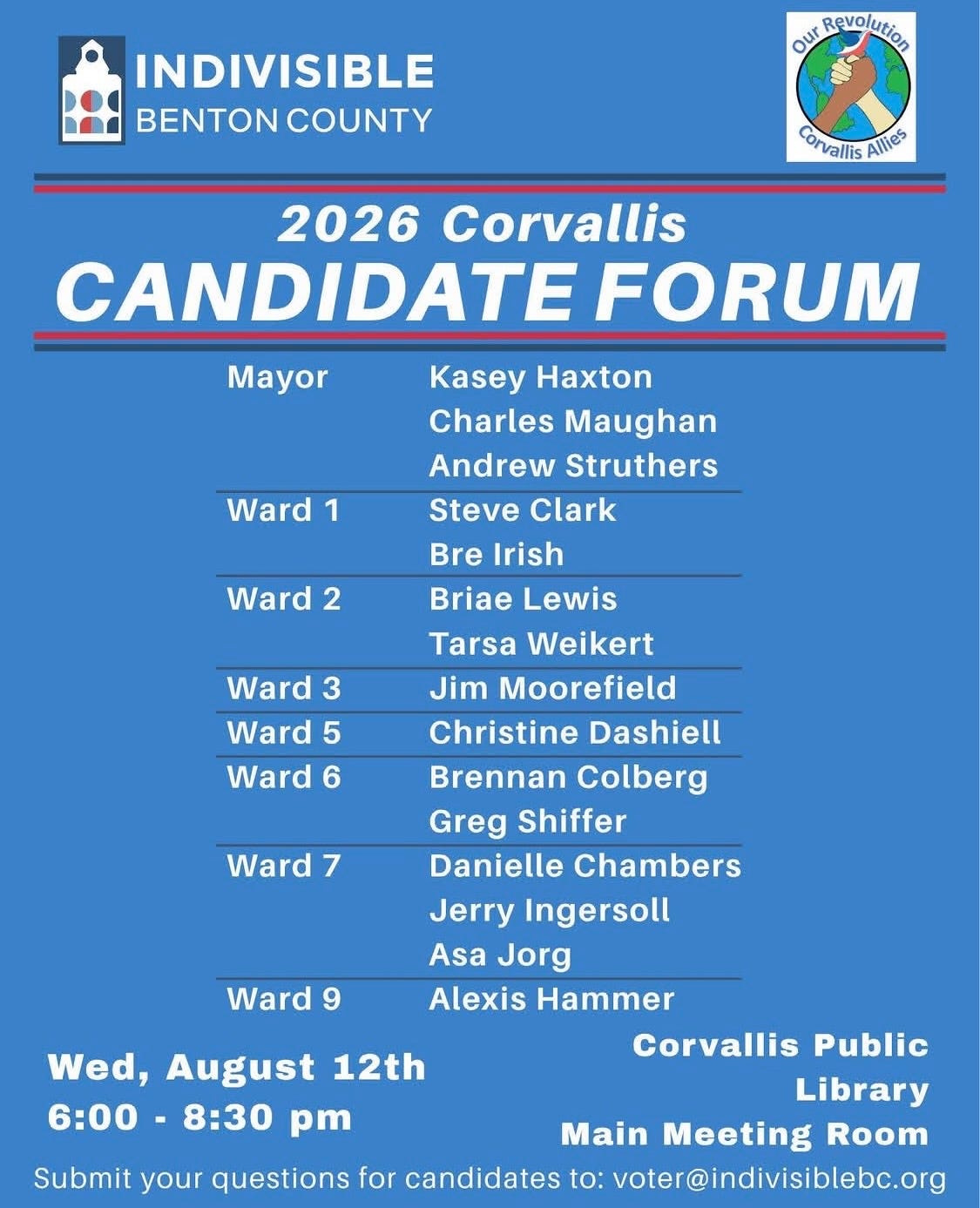
We are live transcribing the 2026 Candidate Forum for Corvallis City Council and The Mayors office. Candidate transcriptions should be available below within a few seconds after each candidate speaks. The forum started at 6:00pm at The Corvallis Public Library…
The forum is sponsored by Indivisible Benton County. We’ll be live transcribing the first 12 minutes - 15 minutes of each Ward.
Transcripts coming below:

Round 1:
Bre Irish and Steven Clark - Ward 1
Moderator
In the questionnaire, we asked a question about taxation, so I want to make sure that, at some point, you cover that — and the same for you, Bre.
But I’d like you to give an introductory presentation first, if you would.
Thank you.
Steve Clark — Opening Statement
Hi, everyone.
I’d like to thank everyone for being here tonight — our hosts, most certainly, and all the candidates.
This is a perfectly great example of civics in America. I applaud you all for being part of the civics lesson tonight.
So, let’s look at what we have before us over the next three months and into the future. We really have a generational moment in time in Corvallis. We have an essential time to be voters, but then to act after the election.
I’m running to represent Ward 1. If elected, though, I will guarantee you that I will represent all of Corvallis, not just my ward.
A bit about me: I’m a lifelong Oregonian and a resident of Corvallis since 2013.
For more than three decades, I worked as a newspaper publisher in Portland. I served and volunteered in my communities. I served in local, Portland regional, and state governmental matters.
I was appointed by two governors to help address land-use issues in the state, economic development, transportation — the broad range of transportation, from biking and pedestrian to highways and bridges — the environment, and public safety.
On local, regional, and statewide economic development, I helped to bring about change that really, I think, has fostered a 21st-century economy that’s starting to find its way in Oregon, that brings agriculture, forestry, high tech, and retail together.
I served as a gubernatorial appointee on the TriMet Board of Directors and helped to bring suburban transit to the region in Portland, where it really was not possible before.
For 12 years, I served as Oregon State’s vice president of University Relations at a time when the university was not connected with the community. We made it a priority that we would be, and that we would learn from each other and work together to solve numerous important issues.
Since retiring, I’ve coached a couple of youth basketball teams.
I helped co-chair two task forces for the city, most recently the Downtown Vitality Strategy Task Force, which just concluded its work and provided that to the City Council.
I’ve attended many dozens of City Council meetings, and I think some of our councilors here tonight would say I’ve testified at many and helped try to steer public policy.
I have the experience, I think, you need on the City Council. I’ve helped shape, create, and adopt public policy. I could start my job on January 1st running hard for you.
So, what do I believe in?
We must reduce the high cost of living in Corvallis. We must provide for more affordable and available housing — yes, infill from ADUs and middle housing, but more than that.
We must improve our downtown’s vitality and safety.
We must work with others because the city is not a nonprofit provider. It’s not a provider itself. It’s a partner in public services to address the issues and impacts of houselessness.
As I said before, we must provide for jobs and economic opportunity locally.
But we have a problem. We talk a lot about things in Corvallis, but we don’t get much done.
And that’s what I’m here and prepared to do: work with you to provide for change so that we do get things done that benefit all of our community.
As I said, I can make a difference immediately. I have that public policy experience.
I hope I can earn your vote in the next three months, and I thank each of you and our candidates for being here tonight.
Let’s do better together.
Moderator
Very nice. Thank you.
Now, Bri, would you do us the honor?
Bri Irish — Opening Statement
Hi, everybody.
My name is Bri Irish, and I want to thank Indivisible and Our Revolution for holding this forum.
I’m really happy to see such a full room. This is really, really cool.
I’m running for Ward 1 on the Corvallis City Council. Before I jump into what I believe, I’d like to talk a little bit about myself and my background.
I worked for the federal government for many years. I was a staffer for Senator Ron Wyden, handling his education policy portfolio, as well as his labor, finance, and healthcare policy portfolio.
I also organized on the Hill a lot. I helped create what is now the largest staff association in Washington, D.C., representing congressional staffers, and negotiated directly with Senators Chuck Schumer, Mitch McConnell, and Speaker Pelosi to secure pay raises for Senate and House staffers as well.
That’s one of the things that I’m most proud of in my life, to be honest with you.
I was deeply involved in a lot of policy, so I’m really happy that we have that in common, Steve.
I worked hand in hand with local governments on wildfire response and on tariff relief when President Trump’s tariffs really devastated a lot of our local economies.
I was tasked with organizing local, state, county, and federal leaders to coordinate the response to many, many things. I was essentially Senator Wyden when he wasn’t in town, and if there was a federal nexus, I had to figure it out.
So, I learned a lot about a lot of things, and I’m really looking forward to putting that knowledge to use for Corvallis.
Here in Corvallis, I am a graduate of Oregon State University, and I’m an active volunteer. I volunteer as a team lead for the street outreach team at the Corvallis Daytime Drop-in Center, where we have connected with our unhoused neighbors to support them and get them connected to treatment programs, housing, jobs, etc.
It really touches my heart because my family also struggled with homelessness when I was in school, and it is vitally important to me that we support our community members, whether they’re housed or unhoused, because to me, they’re just as important.
I’m running because I fervently believe that we need to do more for our families and our communities.
I’m running because the thriving and better life for all that we want is becoming increasingly out of reach for too many of us — for our young people, for our seniors, for people with disabilities, for far too many people.
I’ve worked in policy and government for years now, and one thing that is crystal clear to me is Oregonians are really tired of business as usual. I think folks in Corvallis really echo those sentiments as well.
The business as usual that keeps stressing them out with bills, fearful that they’re not going to make ends meet. The cost of childcare, housing, etc., is really keeping the better life that we all want increasingly out of reach.
And that is what a government exists for, in my opinion: to support and invest in the people in particular.
Corvallis residents deserve candidates and elected officials who know what it’s like to worry about how you’re going to pay your bills, how you’re going to put gas in your car, and how you’re going to pay for your prescriptions.
Those are deep problems that every one of us — and too many of us — face at this point in time, and something needs to change.
I’m tired of hearing the same excuses about why good things can’t be done in our lives while we watch some pretty horrible things happen very easily — all too easily.
I’m running so that I can buy a house someday, so that you can buy a house someday, so that my friends can buy houses, and so that my grandparents can afford a home that is accessible for them to retire in.
I’m running for college students who need a cheap place to live while they’re in school, and for the families who want to grow.
As we’re closing schools and seeing our population and enrollment decline, we really need to make Corvallis a thriving place to raise a family.
And I am working to invest in childcare. I’m working with a growing coalition of people to make sure that we’re investing in our workforce because economic development means more than just giving businesses tax breaks. It means investing in us and the workers who do the work to make those profits happen.
I am excited to bring as many people as possible into that coalition because I believe that strong communities are the building blocks of a strong economy as well.
When we make things affordable, when we make opportunities for people to thrive, I strongly believe that benefits everybody.
I’m running for City Council, and if I win, I would love to start investing in the people who make that success happen, which is everybody in this room.
Thank you.
Question: Corvallis Budget and Municipal Fees
Moderator to Steve Clark
In response to the unbalanced budget that we have in Corvallis and the need to address this imbalance, you said that you would like to reduce municipal fees on middle- and lower-income people.
Specifically, how would you do that and still balance the budget?
Steve Clark
What I have to offer you is a strategy that connects housing, the economy, taxes, and livability together.
We must do that as a unified approach to addressing these many matters.
What I’ve said to the council in testimony is that the council should budget and balance the current fiscal year and the next two fiscal years with available resources that we presently have, and reach out to the community, the employers, and commuting employees who come here — about 20,000 — to work here but cannot afford to live here.
Reach out to them and understand their needs and what they will afford, what they might afford, in the form of taxes.
By understanding that, with the employers, with the employees presently here, and those who come here, we can create a uniform tax policy for the future and address long-term needs to build services for our community, as well as facilities in a timed way — a City Hall, a police facility sometime in the future.
This is how I testified to the council.
As it relates to how we improve and lower the cost of living here, if we had an economic strategy that created jobs and places of employment, we would have more businesses paying property taxes — not big smokestacks.
And as a result of that, that would begin to reduce the burden on people like yourselves who pay property taxes as residents.
Question: Shifting the Tax Burden
Moderator to Bri Irish
Bri, as I said, the budget of the city is not balanced, and one of the things that you emphasized is that we need to find a way to shift the tax burden from individuals to businesses and widen our tax base.
Specifically, how would you do that?
Bri Irish
There’s been a lot of conversation lately about people paying their fair share in taxes.
I’ve been an active participant in the state legislature advocating for widening our tax base, specifically the ultra-rich in the state who do not pay their fair share.
So, I think it really starts from there, increasing the tax that we pull from the ultra-wealthy.
That eventually trickles down because the State of Oregon supports the city as well as the county.
And I also think that that should happen here as well.
Moderator
Very good. Thank you.
Now, I’m going to turn to a question from the audience. It has to do with the relationship between the candidates and Oregon State University.
Question: Oregon State University and Corvallis
Moderator to Steve Clark
Mr. Clark, you have a very long history of being an advocate for OSU.
What is the attitude the city should take toward OSU and its students?
Steve Clark
If any of you lived in Corvallis in 2009 to 2011, you might have seen or remembered 3,000 to 5,000 students coming in during those years after the Great Recession.
I arrived in 2011.
There was no relationship between this community and the university, nor the city.
Former Mayor Julie Manning, Ed Ray, myself, and others, through Mayor Manning, created a group called Collaboration Corvallis.
This group worked for about two and a half years to address issues such as livability, student behavior, transportation, parking on streets, parking on campus, transit, safety in our communities, and land use.
The university didn’t build all the row houses. Infill is a good thing, but how do we manage infill?
So, what we worked on, and what I championed, was that we would work with the community. We held more than three dozen meetings over those three years, both on and off campus, to create change.
Was I the spokesperson for the university? Yes. That was my official job. In good and bad times, when we screwed up or when someone died, that was my job.
But what I was — and I think if Ed Ray was in this room or Julie Manning was here, they would say — was the voice of accountability, that we would be a community partner, not only in Corvallis, but throughout Benton County and throughout Oregon, and champion relationships with people that listen, learn, and grow from.
Moderator to Bri Irish
To town-gown relations, or how OSU and the city should work together?
Bri Irish
As Steve talked about, the university and Corvallis have deep ties going back many years.
I think that’s incredible because the university provides a lot of the economic mobility for this city as well.
I would love to foster more communication and more connection, as well as see how more investments can be pulled from the university as a more involved financial partner with the city — and the county as well, but that’s not my jurisdiction.
Moderator
Thank you.
Bri, I should have just let you keep standing. I’m going to ask another question.
Question: Making Childcare More Affordable
Moderator to Bri Irish
Bri, one of the things that you advocate for, even in this fiscally constrained environment, is for the city to make childcare more affordable.
How would you do that?
Bri Irish
I’m really excited. It’s not just myself, but there is a really cool coalition of candidates that we’re working on this together.
Childcare was one of the policies that I did work on for Senator Wyden in D.C.
We’ve seen the successes of Preschool for All in Multnomah County and how it has led to increased childcare accessibility and affordability for families.
We have been looking to replicate that model here, starting in Corvallis.
Obviously, it’s not a copy-and-paste model because the communities are different. That’s a county, and we’re a city. We have a lot to do to get to that point.
First off, we need more income information for citizens of Corvallis so we can really make a targeted approach to potentially a progressive tax down the road to support our childcare.
I see this as a big building block in our economic vitality and growth. If you’re not paying $2,000 a month for childcare, you could probably spend that in other ways. Maybe you could afford to buy a house because that’s, you know, around a mortgage payment as well.
So, I think investing in working people like that is really at the core of who I am because working people make things happen, and we have to provide the opportunity for working people to thrive and live and have children, if they so choose, or spend their money downtown.
Moderator
Thank you, Bri.
That was a very nice segue because Steve Clark has emphasized he’d like to focus on one of his priorities — not all — but one of his priorities is to revitalize downtown Corvallis.
I’d like to know just a little more detail.
Question: Revitalizing Downtown Corvallis
Moderator to Steve Clark
How would you do that?
Steve Clark
As we have over the last year, reach out to the public to engage in what are the priorities for the community.
What we heard, beginning three years ago, was that community safety, the environment, and the economy downtown were priorities for this community — not, at this time, a new City Hall, or unfortunately, a police facility, which actually is a severe need.
So, priority one: work with the public, private sector, local governments, including the county, to address the needs of downtown.
The private sector is already engaged in it. The city is engaged in discussions around urban renewal.
Work with the university. Work with nonprofits. Collaborate.
And I think we will get somewhere more quickly than you can anticipate on many of the other issues facing our community.
Round 2:
Briae Lewis and Tarsa Weikert - Ward 2
Moderator
What we will do next is follow the same routine of having them give a short presentation, and then I will ask a couple of questions.
I’m very happy to ask questions from the audience, so get me some so that I can ask some. I do have some questions myself, but please, the more the merrier.
And this time, just for fun, let’s start with Briae first.
Thank you.
Briae Lewis — Opening Statement
Good afternoon — good evening.
My name is Briae Lewis. I’m your current Ward 2 City Councilor, and I’ve been your City Councilor since 2023.
I’m running for reelection because this community has given me so much since I’ve moved here in 2019, and I want to continue giving back to a community that gave me a second chance at life.
As most of you probably know, I was born and raised in Maryland, which is on the other side of the country. I was in a very, very dark place before I decided that I needed to change my life.
And so I moved to this beautiful community at the very beginning of COVID. I have literally had my boots on the ground here since 2020, when everything was happening.
A little bit more about my background: My mom immigrated from Sierra Leone, West Africa, for college, and that’s when she met my dad. I was born in 1993.
Unfortunately, in 2008, she passed away from breast cancer. Since then, it was a very broad reality check of how easily one can become homeless.
I experienced that because she was our primary caretaker and our dad was not in stable housing. So my brother, my dad, and I were very unstable for a very long time.
I was able to still attend college, but being able to go to college and also afford living was not feasible. So, unfortunately, I dropped out twice.
It was a very difficult time, and that is where all of that began.
After I realized I needed a big change, I moved out here with my partner in 2019, and now we both work over 40 hours a week just to afford basic living and expenses.
It is not fun.
So, in 2022, I decided to make a change in that. I ran for election for the very first time and won, thanks to all of your support.
I continue to show that support you’ve given me by voting for policies that support housing development, policies that make a local difference to climate emissions, and actions to improve transportation alternatives.
I was also born and raised on public transportation, as my mother worked for the Washington Metropolitan Area Transit Authority.
So, I will not get on my pedestal on transportation, but I am a strong believer that alternative transportation is important.
I’m also a known supporter of our business right-of-way program that allows our local businesses to use public parking spaces in order to have outdoor seating. That was very critical, especially in 2020.
I’m very glad that is now an annual thing every summer, and it shows our community coming out more and more to be together, especially when the weather is beautiful outside.
I am an openly gay person. I have talked about this constantly.
I also work 40 to 50 hours a week, sometimes more, because I am hourly. I tell everyone that, especially if you’re working hourly wages, you are one bad paycheck away from being homeless. That has happened to me multiple times.
I recently moved in February from a one-bedroom apartment that was going to be $1,900 a month. We just could not afford that.
And so I know very well, and I’ve experienced very well, how much the housing crisis is affecting not only elected officials, but everyone.
I also want to be a voice for people who could be overlooked.
Historically, Oregon has been very white, and that is because of our history throughout America.
I want to be a voice, and I want to be a beacon for people to understand that no matter your level of degree, no matter who you are, no matter where you’re from, you can still be an elected official.
You can still run for office.
You can still do what you can to support your family, to be in your community, and to just be proud of the person that you are and have become.
We already have at least six new councilors — at least six new councilors.
And so I want to also be that stability on the council, especially since we have a lot of distrust in our federal government.
So, with your support, I would love to be reelected for another term.
Thank you.
Moderator
Thank you very much.
And now, Tarsa Weikert, could you come up?
Tarsa Weikert — Opening Statement
If it’s okay with you guys, I’m going to pace. I’ve been inside an office all day.
My name is Tarsa. I live on 18th Street off of Harrison Boulevard.
I work 55 hours a week at a law firm. We specifically focus on personal injuries, so I have a lot of experience there just applying fact to law and seeing how a lot of policies are implemented and impact the litigation system.
I spend a lot of time at trials. Probably my favorite thing to do.
I’m also currently a planning commissioner for the City of Corvallis, and if anybody wants to apply to do that in the future, I’d really encourage you to do so.
A lot of the things that I care about specifically involve affordable housing, which you’re going to hear echoed, I think, throughout the entire day.
In addition to safer streets — that’s partially coming from my work at a personal injury law firm. I live at a very dangerous intersection. If anybody’s talked to me, I’ve probably mentioned it to you.
I also believe in community engagement as well.
That’s kind of the foundation of my degree, everything that I believe in, and I’m also going to make a pitch right now: I hope that all of you, at some point, run for office and make your voices known, in addition to encouraging other people.
I deeply believe that an engaged community is going to be the best solution to all of the problems that we are currently facing.
In addition to all my platform items, I just deeply care about politics. I care about this community.
I specifically got my master’s in applied ethics, where I focused on political and social philosophy, and I studied the systems that are in place that are kind of causing all of the harms that all of us are experiencing.
I specifically only went to get my master’s degree because of the insurrection and everything that I saw occurring there. I wanted to be part of the solution.
So, I believe that based on my knowledge, my skills, and everything I’ve ever gone through in life — which I hope you read in the questionnaire, and you’ll see that — I would be a prime candidate to be able to solve problems and come ready to every meeting with three potential solutions and three potential pathways to achieve that, because that is what I am mandated to do at my job.
So, I will also do that as an elected official.
And that’s just a little bit about me.
I wanted to take the opportunity, though, because I can only pass these out myself: Would anybody like a pamphlet of mine?
I’m going to take my last few minutes to do so.
Thank you.
Question: What Would You Cut From the City Budget?
Moderator to Briae Lewis
I’d now like to ask some questions where the candidates differ in the questionnaire, which, once again, will be on our website if you want to dig in more deeply.
Briae, you have the advantage — or maybe the disadvantage — of being an incumbent, so you know the city budget extremely well.
I would like you to use a magic wand and tell us: Which program would you eliminate in the city budget, and why?
Briae Lewis
That is very difficult because we depend on a lot of services, and a lot of the services we provide are definitely there to help those especially who need it the most, like our elderly, our disabled, and our unhoused.
So, if I were to get rid of one, it would probably be a combination...
Well, let me start with library delivery.
Library delivery, I’ll start with, because we do have our bus transportation system. Although it can be improved, and it needs to be improved, I feel like we still have a way for everyone to be able to access our public resources.
So, I would get rid of library delivery.
Another one that would seem to be cut would probably also be our...
Oh, this is such a... I know there’s so many.
I’m going to stop there because I think that one is the one that most comes to mind.
Moderator
Just to clarify for a second: Why that one? What is it about that program? Why would you cut that one?
Briae Lewis
I would cut that one specifically because we have different ways for people to access our public resources.
Moderator
Thank you. I just wanted clarity.
Question: Encouraging Businesses to Come to Corvallis
Moderator to Tarsa Weikert
Unfortunately, Tarsa, I don’t have such a tough question for you, but I have one that approximates it.
You have proposed that you’d like to make it easier for businesses to come to Corvallis.
Given that we’re under some budgetary stress, how would you propose to encourage businesses to locate here?
Tarsa Weikert
Part of it is just making it easier for businesses to be able to go through the application process, find space, and then also, specifically, making sure that the infrastructure of the individual properties that they’re trying to develop in is ready and available for them.
I’ve heard different businesspeople talk about how they have had to pay money out of their own pocket to solve some of the structural issues of the businesses that they’re deciding to rent here in downtown Corvallis.
Outside of that, just making the application process a little bit simpler and easier to go through.
I believe that that’s a partial reason why people are taking so long to be able to develop their businesses downtown.
And I think I’ve answered that.
Moderator
Very good. Very good.
I have a question from the audience.
Question: Revitalizing Downtown Corvallis
Moderator
Ward 2 includes downtown, and many of the candidates speak about revitalization or encouragement of the downtown area for businesses.
Be very specific: What would you do to help revitalize downtown Corvallis?
I’m going to start with you, Briae.
Briae Lewis
One thing that I would do to revitalize downtown is definitely make it more affordable to be downtown.
Not only are our housing prices high, but so are our building rents.
A lot of our rents are very high, and it detracts a lot of businesses, especially those who want to just be entrepreneurs.
And that is really the life force of not even just Corvallis, not even just Oregon, but America in general. We thrive on entrepreneurship, and we thrive on our individuality.
Not being able to even get those basics because the rent is too high is just not feasible.
So, we are looking into a tax district for downtown.
I’m also part of the DCA events planning, and currently we’re going to have a meeting, I believe, in the next couple of weeks for that.
So, that would also be able to get businesses to participate and get their names out there — our current businesses and our current local businesses — and to be able to showcase that, yes, this is a perfect place for businesses to be here.
It’s just getting those rent prices down.
Moderator
Thank you very much.
Tarsa?
Tarsa Weikert
I do think that downtown revitalization is not just a burden of individual city councilors or elected officials.
It’s also the community members laying out exactly what they want from downtown.
Specifically, I would like to encourage access to the river and increase the diversity of different types of businesses down there, because right now we have mainly eateries, is what I would call them.
I’ve had people that I know, specifically, who have left Corvallis because of the lack of food types. You spend three months eating around Corvallis and you’ve eaten every single place.
Outside of that, there’s just a lack of businesses that actually have activities to do as well.
People want to be able to go downtown and spend their free time, not just eating and drinking. They want to be active.
And I really do think that having more access to the river is going to help us have a more diverse downtown, in addition to having a more diverse city.
At the moment, there’s just not a lot of people who want to stay here, from what I’m aware of, because of what downtown represents and kind of what’s going on, honestly, in Corvallis as well, with the lack of diversity in activities and businesses.
Question: What Would Tarsa Cut From the City Budget?
Moderator
Thank you.
I’ve gotten a question from the audience for Tarsa, detecting a slight unfairness:
What in the city budget would you cut?
Tarsa Weikert
So, I’m going to start with a little bit of obfuscation here.
I would prefer to not have to cut anything in the city budget.
If we prioritized our economic stability in the city, I wouldn’t have to answer this question.
If we had more businesses here in Corvallis being able to contribute to the economy, I still would not have to answer this question.
If I were going to choose one thing, I would specifically consider doing...
There’s a lot of funding going to the Majestic Theatre, and I think that if you put the vote to the people, the people would vote to actually support that outside of having the city fund it.
And that would be the main thing, honestly.
Otherwise, I would never cut library services.
Moderator
Thank you.
I apologize to the audience for the apparent inequity.
But I would like them to ask more about taxation because that seems to be on everyone’s mind.
And so I’m going to ask the same question to both of you.
Question: Where Would You Raise Taxes?
Moderator
With taxation, you can increase taxes uniformly, or you can increase taxes on, let’s say, businesses, property, income, or land developers.
Give us a sense: Where would you raise taxes if you had to?
What would be the mechanism for doing that?
Would you tax businesses, individuals, property, etc.?
We’re going to start with Briae.
Briae Lewis
It really would depend, right?
It depends with a lot of taxation. It’s a lot more complicated than just, “We’re going to raise taxes because we need more money.”
It’s like, where and why are we going to raise taxes?
If I was going to raise taxes on businesses, I would have to have a reason why.
And a lot of that reason would be infrastructure. It would be to fund our current services. It would be to help bridge the gap.
However, they have to understand, again, like I said earlier, everyone can be one bad paycheck away from being homeless.
So, why would I give that to a business owner? Why would I do that to an individual who just paid off their mortgage? Why would I do that to our school services?
So, it really just depends on the reason and the severity of why I would need to raise taxes.
Moderator
Tarsa?
Tarsa Weikert
For me, it’s going to be specifically land developers, and a little bit of homeowners.
And I will explain why.
One, land developers have the opportunity and financial ability to be able to develop land, so therefore, theoretically, the burden could be placed more onto people who actually have money to be able to solve that.
Again, a little bit of obfuscation: If we had a better economic system, I wouldn’t have to raise taxes, which is really what I want to do — try to prevent raising taxes in general.
And that goes back to the same reason why property owners I would tax. Because you own a home — it is impossible to own a home right now — and honestly, if you can help contribute to the economic stability of Corvallis and everybody else’s livelihood, I think that’s a great burden to bear, even though financially it might be a hardship.
Round 3:
Brennan Colberg and Greg Shiffer - Ward 6
Moderator
Are there any questions from the audience for this ward yet?
If not, please — it looks like there are a couple.
Very good.
So, Greg, would you start with a general statement of why you’re running?
Greg Schiffer — Opening Statement
Okay. Good evening, number one.
Thank you all for being here. It’s great to see some familiar faces here. It’s really great to see everybody out here with such a great turnout.
So, this is what democracy looks like, right?
I really appreciate everybody being here. I appreciate Our Revolution and Indivisible for organizing this event tonight.
My name is Greg Schiffer, and I’m running for Corvallis City Council here in Ward 6.
You want to know why I’m running, and I’m running because I love Corvallis. I really believe in the future of Corvallis.
I’m a little worried about the future for Corvallis.
I’ve been a public servant for most of my career, and I want to continue to serve my community by being a city councilor.
A little background about me: I’ve lived here for about five years. My experiences and career up to this point have been quite varied. I’ve lived a lot of places and had a bunch of positions.
But my passion and commitment to environmental, social, economic, and racial justice have been consistent throughout that time.
I grew up in New Jersey. I attended college in Pennsylvania, moved out to California, and went to graduate school in Berkeley, California.
I got two master’s degrees, one in civil engineering and one in city planning.
From there, I started work as a public transportation planner. We talked about public transit tonight, so that’s exciting for me.
I worked for six years as a public transportation planner in Oakland, California, where I focused my work on the people with the most needs, trying to connect them to jobs, recreation, religious and community centers, shopping, schools — everything that they need to get to if they didn’t have access to a vehicle.
Later in my career, I moved out of the country. I ran an ecotourism business in Colombia, South America, for four years.
When I came back to the U.S. after several years, I decided I wanted to work for the National Park Service. So, I became a National Park ranger and worked as an interpretive ranger, helping to educate people and inspire stewardship of our most valuable, precious resources in iconic places.
I did that for about seven years, seasonally, including at Crater Lake here in Oregon.
Then, after I moved to Corvallis, I was hired as an outdoor recreation planner with the Bureau of Land Management in Springfield, Oregon.
I worked there until the Trump administration took office in 2025 and completely changed the working conditions and the benefits that were associated with that position, and basically forced me to resign.
My spouse and I love living in Corvallis because it’s such a diverse, inclusive, engaged, and progressive community that values and respects all people from all backgrounds.
The city is facing big fiscal challenges in the coming years, and I want to make sure that the city budget is not balanced on the backs of working people and the people who can least afford to pay it.
So, that’s a big priority for me.
I want to see a more progressive city tax system that forces wealthy residents and non-resident workers who commute in to pay their fair share for city services, including large institutions like the hospital and university.
And I want to lower city service fees that disproportionately burden the lowest-income people and the people who are least able to afford it.
So yes, I want to raise taxes, but I really want to do that on the top 10 to 20% of people. Because of that, I think that’s going to allow us to reduce city service fees.
I want to build community resilience to the effects of climate change by investing more in mitigation and adaptation programs.
That’s a big priority for me as well.
Heat waves, red flag days, bad air quality days, which we recently experienced, ice and wind storms, and flood risks are all going to continue to increase in the future thanks to climate change.
And we need to be prepared for it.
We need to harden our homes. We need to help people afford better appliances, heat pumps, and better insulation for their homes, and we need to focus our investments on, again, the people who are least able to afford these things.
So, that’s going to help us achieve our climate goals and help people save money.
That’s a big key, and that is affordability as well.
I want to especially protect people who have housing insecurity, lack air conditioning, or can’t afford to turn their air conditioning on.
Those are all things that are going to get worse with climate change and things that the city needs to be investing more in.
And increasing the city’s urban forestry program so that we’re planting trees in neighborhoods that need them the most.
There are ways that are out there now to figure out where they are.
A lot of those neighborhoods are places, again, where we have the most vulnerable neighbors, and heat risk is really intense if you don’t have a place to get away from it.
I want to protect all members of our community from harassment, surveillance, and discrimination, especially members of immigrant, LGBTQ, disabled, and Black and brown communities being targeted by the horrific actions of the Trump administration.
I want to minimize surveillance technologies. I want a moratorium on large data centers, and I want a vibrant downtown, sustainable transportation system, and more mixed-use and affordable housing development.
Complete the neighborhood bikeway network. Electrify the buses.
I think that’s it.
Thank you.
Moderator
I think you got it all. Thank you.
And now, Brendan Colberg, if you’d do the same.
Brendan Colberg — Opening Statement
Hello, everybody.
I’m Brendan Colberg.
I’ve lived in Corvallis since 2019, and when I moved here, my wife was in school here and I was working remotely.
She graduated a few years ago, and we decided to stick around after doing the whole inventory of places in which we could live in the Northwest, and Corvallis kept popping out of our upper rows.
So, that was nice and convenient.
I got involved in city politics sometime around 2023. I was looking at different tax policies around development and got very interested in land value taxation as a tool to promote development intensification.
I went to the City Council to talk about it, only to learn that that’s still more of a state-level constitutional thing.
But Laurie Chaplen, our former Ward 6 councilor, had to retire, and she tapped me to run in her place. I wasn’t selected last cycle.
But some more people started tapping on my shoulder to run this year.
I basically think Corvallis is in a very unique position.
We are a university town with a whole ton of government services, with a whole ton of retirees.
I heard — I’ve never verified this — but in a magazine a while back that Corvallis was once described as the best college town to retire to.
And if that doesn’t say it all...
The problem with college students, though, and retirees, and nonprofit organizations like the hospital, like OSU, like the HP complex that the state government has given a 90% tax write-off on their property taxes, is that they don’t pay taxes.
And so we’re running a full...
I mean, no offense to the retirees. I know you do pay taxes, and students do too. But it’s not the same as most other governments have to work with.
And so this is how we’re running into lots of budget gaps.
We don’t have a strong economy here.
We have everything else, but not a strong economy.
And everything comes back to — you’re hearing lots today, and we’ll hear more about wish-list items, things we wish we could subsidize, things we wish we could spend money on.
But we don’t have that money.
We don’t even have the money to maintain our current services.
And so all that talking is nice, but it’s kind of moot until we look at the core.
The panacea to the problems that Corvallis faces is economic development.
We need to make it possible for people and institutions and organizations with money — we need to make it possible and easy for them to spend that money improving our community in ways that the community would benefit from.
That’s how wealth is created.
That’s how economies grow.
And that’s what Corvallis is ultimately lacking.
So, I would, as a city councilor, have a laser focus on economic development.
Our affordability — you know, there are two sides of the equation. One is the cost, and the other is how much people have in their pocket.
Even the cost is downstream of this.
Housing is an input into a whole ton of cost structures in economics. It’s a lot like electricity in many ways.
I have a young family. I have a two-year-old daughter and another daughter who’s going to be born next month.
There’s no place to buy children’s clothes in Corvallis.
You can’t do it.
There’s some at Goodwill, but not much.
The reason there aren’t any children’s clothes boutiques in Corvallis, the reason Fred Meyer doesn’t have a children’s section, is because there aren’t any families in Corvallis.
The reason there aren’t any families in Corvallis is because there aren’t any well-paying jobs.
Obviously, I’m overgeneralizing a lot, but this is all true relative to other communities, relative to Albany.
I’m fortunate to attend a church with a large and vibrant population of young families. I think there are eight or 10 — we have eight to 10 babies a year.
And a lot of these people, almost all of them, they work in Corvallis. They grew up in Corvallis. They live in Corvallis, or would if they could.
They work in Corvallis. Their friends are in Corvallis. They go to church in Corvallis.
But they live in — well, off the top of my head, one lives in Albany, another lives in Albany, another lives in Albany, one lives in Philomath, one lives in unincorporated Benton County past Philomath — because they can’t afford it.
We can talk about what we would like to have, but public policy is ultimately a matter of trade-offs.
I didn’t say much about myself.
I’m a software guy. I’m a business guy.
I look at systems, and I optimize them for a living.
I look at incentives. I look at structures.
What we need to do is take a solid look at the incentives and the structures around economic development in Corvallis and pour everything we have into it.
All our nice things are downstream of that.
Public transit is downstream of that. Street trees — I love these things as much as the next guy.
But the City Council has the duty to look the biggest problems we have directly in the eyes and spend all their time on that.
And that’s what it is.
Moderator
Thank you.
If you look at the questionnaire that was submitted by these two candidates, they differ markedly in the area of education.
But there’s one project that I’d like to get some comments on that was not covered in the questionnaire.
And that is that the Corvallis School District and the City of Corvallis have worked together to keep the Osborn Aquatic Center operating.
The school district is embarking on a major campaign to repair and reopen Osborn.
Question: Osborn Aquatic Center
Moderator to Greg Schiffer
What are your thoughts about the partnership between the school district and the city?
We’ll start with you, Greg.
Greg Schiffer
Thank you.
I know that the Osborn Aquatic Center is a really important resource for a lot of members of our community, and so I do think that the city needs to work closely with the school district.
They both have different roles when it comes to maintaining that facility, and it’s really important that we get together as a City Council, that we get together with the School Board members, and figure out the best way to do that.
So, yeah. Thanks.
Moderator
Thank you.
And Brendan, what’s your thought on Osborn?
Brendan Colberg
Well, it’s a good center.
I like going there.
My understanding is that it’s owned by one entity and operated by the other.
If I recall correctly, it’s owned by the school district and operated by the city. So, there’s a lot of overlap and negotiation in that.
The recent problem, if I remember correctly, is that some of the roof rafters have sort of corroded, and there’s a big capital bill that’s coming due, and it’s sort of unclear how we’re going to do that.
I haven’t been plugged into the situation.
I think we’re making meaningful progress on that.
I know we secured some state and federal funding to help with those repairs.
I don’t see too much of a need for any structural changes in that situation.
You know, occasionally we miss maintenance things, and that’s just how it goes.
But I don’t know enough details to specify any way I would improve on that.
Moderator
Thank you for your answer.
One of the big concerns that came across often in the questionnaire was the idea of locating data centers near or in Corvallis.
And, of course, the candidates say that they’re against data centers, and I understand that.
But I want to ask a slightly more difficult question.
One of the things that’s happening with data centers is the businesses behind them are starting to say things like, “We will pay one-half of your electric bill. For the next decade, all of your electric fees will drop.”
We know that’s an issue.
“We will also provide your city with budget-balancing, free money.”
Question: Would You Allow a Data Center if It Reduced Utility Costs and Provided Revenue?
Moderator
If a data center offered those two things to the City of Corvallis, would you still deny the construction of a data center near Corvallis?
Greg?
Greg Schiffer
So, Brendan and I actually both have to be very careful about answering this question because we are both on the Planning Commission.
We are not allowed to take a position on land-use issues, on things that could come before the Planning Commission, before they come before the Planning Commission.
But as far as city policies go, like I said, I support a moratorium on new data center applications until we can revise the city’s land development code to take into account the effects that some of these data centers are going to have on our energy consumption, on our water consumption.
These are things that are very hard to predict.
So, even a 10-year window for something like that — they can have impacts that go way beyond 10 years.
And so that might not be good enough.
I do want to be careful about answering that question specifically, but that’s kind of where my position is on that.
Brendan Colberg
Greg is being very diplomatic.
I didn’t actually submit a questionnaire, so I assume this is being inferred from my minimal public presence.
I’m not actually anti-data center.
I think data centers are fine.
They’re computers in a building that are connected to the internet. This entire thing is being streamed via data centers.
I think if a company wants to come in and spend hundreds of millions or billions of dollars on construction and operation costs in our community, and can certify that they’re going to provide or offset the electricity and our bills aren’t going to go up, anything beyond that is pretty much great.
They have to adhere to pollution laws.
There are noise pollution laws. There are water pollution laws. There are environmental pollution laws.
But Oregon has had a lot of data centers for a long time, and there really haven’t been many problems with them, except that they make our communities and our state a lot more affluent because we get to collect property tax on the value of all those GPUs sitting inside them.
So, I would actually — subject to, of course, Planning Commission constraints — be quite open to development.
Round 4:
Danielle Chambers, Jerry Ingersoll, Asa Jorg - Ward 7
Moderator
For Ward 7, we’re going to take a little more time this time because we have three introductory speeches.
And let’s just go in order.
Danielle?
Danielle Chambers — Opening Statement
Hi, everyone.
My name’s Danielle Chambers, and I am running for City Council because I love Corvallis. And I’m certainly not the first person to say that here.
But when I say I love Corvallis, let me explain to you what I mean.
I was born and raised in Oklahoma, and I lived there my whole life up until about two and a half years ago, when I made the leap here.
In Oklahoma, I spent most of my time miserable.
I spent my time cooped up in my room, even before the pandemic happened. In fact, because I was fortunate enough to have a remote job, the pandemic came and nothing about my life changed.
I stayed inside. I went out for groceries once every two weeks.
It was a lonely, lonely, miserable existence.
That changed when I started my transition after finally figuring out that it’s not normal to live with existential dread every single moment of every single day.
And so, I came to Corvallis to visit my best friend from high school. She moved here to be with her girlfriend, and I still remember that drive out from the Eugene Airport.
I remember it was a beautiful, sun-showery day. I remember seeing the clouds rolling over the mountains, all the greenery, the sky reflecting on the puddles, and I just thought to myself, “This is a place full of life.”
Long story short, I got to Corvallis proper and my socks were blown off.
There are so many things that made it so easy for me to choose to move to Corvallis.
One of them was, when I was at a stop sign, I’d constantly get people waving me on, even though they were there first.
I’m like, “This is amazing.”
I knew from those interactions that Corvallis was a great place to be. It’s a place where people cared about one another, where people were considerate, where there was trust.
And that’s exactly what I needed, especially as a relatively freshly transitioned trans woman, and especially after some of the more dangerous experiences I had in Oklahoma.
I’m running for Corvallis because Corvallis, to me, represents life.
It represents an escape from the living death that I had back in my home state.
And that’s why I want to continue. I want to work to build up what makes Corvallis great, so more people can have the same experience, the same new life that I’ve found here, the same community that I’ve found here.
And so, I’ve jumped in with both feet.
I said, “I want to live here the rest of my life.”
And I started attending every City Council meeting. Long story short, that led to my first — that’s why I’m here on the stage — the 2025 Transgender, Intersex, and Gender-Diverse Sanctuary City Resolution.
Because of the support from Paul Shaffer, the current councilor for Ward 7, he encouraged me to continue down this path.
And I have been. I’ve been so excited to continue working for the city ever since.
It led me to join the Housing Operational Committee for the city in 2025, as well as the Charter Review Task Force Phase 2 for the city.
And so, I decided that I’m ready for the next step.
I want to help Corvallis in this time of trouble, facing these big budget gaps, facing these big existential issues — climate change on our doorstep.
The fact that I’ve had friends I’ve made here who have had to move away because they can’t afford to live here, as has also been mentioned.
And so, that’s why I’m running on a platform:
First, building up our local economy.
Second, addressing housing and housing affordability at the roots.
And keeping the greenery, keeping Corvallis sustainable, because that’s one of the things that makes it truly beautiful and wonderful to live here.
And so, that’s why I’m running for you, Corvallis.
Thank you.
Moderator
Thank you very much.
Jerry, would you give us some background?
Jerry Ingersoll — Opening Statement
I love the ideals that Corvallis represents.
I love this community.
I think everything you just said, Danielle, resonates with what I think this community brings.
I’m Jerry Ingersoll, running for Ward 7 City Council.
I just retired at the end of April after 38 years of public service with the U.S. Forest Service.
I’m a 16-year Corvallis resident. I raised three kids here with my wife, Millie, in the back. All graduates of CHS, all gone on to live their own lives and go on to successes.
One of my themes, and what I’ve devoted my career to, is service.
And I believe in service.
I think it unites all of the people who speak to you this evening — a desire to give back to our collective community.
And it is great that we have candidates who are not running against each other, but with each other, for service and for serving this community.
I’ve spent my career serving others across America and stewarding our public lands.
Now that I’m retired, I want to focus at home and to serve you and this community, and to keep Corvallis the special place that I think all of us know it is.
I want to use the experiences I’ve gained in managing budgets, in leading large organizations, and in bringing people together across political differences to address the needs of our community here at home.
As Forest Supervisor of the Siuslaw National Forest, I brought together loggers and environmental groups and local landowners and watershed councils to provide sustainable restoration of ecosystems.
I went on from that job. Before I did, I was recognized in the Gazette-Times for leadership, collaboration, and diplomacy.
I went on from that job to lead the Forest Service Job Corps program across the country, where we managed 24 campuses, giving underserved youth a chance to change their lives and get great careers.
In the process, I supervised over 1,000 federal employees and also administered a budget, in times of really severe budget cuts, of over $170 million annually.
Through all of that, my values have been: It’s not about me.
It’s about the community members.
So, my commitment is to serve voters and residents, to provide good government, to help balance our costs with our revenues, and to help connect Corvallis citizens with the government that serves them.
It’s about you, not about me.
I think you’ve heard a lot about the greatest challenge facing Corvallis today: affordability.
In my own neighborhood, when we moved here in 2010, there were many families with kids in the Corvallis schools, including ours.
Our kids grew up and moved away, and so did our neighbors. Today, there are very few kids in our neighborhood.
And the schools have had to close schools.
Affordability is the greatest challenge we face as a community.
As a city government, I think the greatest challenge we face is the gap between our projected costs and our projected revenues.
I would bring focus to those issues and to the work of the city government, to focus on the things that are within the purview of the city, to bring our costs and our revenues in line, and to reach across divides and work together.
Thank you.
Moderator
Thank you very much.
Asa?
Asa Jorg — Opening Statement
Thank you.
Thank you for putting this on.
I’m Asa Jorg.
A little bit about myself first.
I’m a pre-med student at OSU. I’ve been here three years, and I’m going to say something a little bit different than that.
You know, I didn’t actually like Corvallis when I first came here.
But it’s really grown on me.
Over the last year, it’s become a community that I feel like I could really see myself staying in, if the job market and housing market allow.
I was born to union parents up in Portland. My mother, an immigrant worker; my father, a builder.
My mother would work, you know, six days a week, 10, 12 hours a day. My father would work sometimes 13 days in a row, nights even.
I, and most of the folks in my generation, we’ve witnessed firsthand the downstream effects of a system that puts business interests first and working families and communities last.
From very early on in my time in Portland, I’ve been involved in organizing for our community and for our working people.
In 2023, we had a months-long historic teachers’ strike from the Portland Association of Teachers.
I was a student strike leader for that.
We organized demonstrations in front of the administration building.
A year before that, the Portland Public School system was plagued by a rash of multiple students dying from fentanyl overdoses.
I, and a group of my friends, ran a campaign in my high school where we partnered with community organizations to provide hundreds of fentanyl test kits for all of our students.
Harm reduction.
I’ve been a leader on engineering teams for almost some years now — almost half my life.
I’ve handled project management and budget management, both.
I’ve been treasurer on most organizations — every organization, actually — that I’ve been on at the university in my time here.
That is to say, I’m young. Make no mistake.
My formative political experience was actually back with Occupy Wall Street in 2011, so that gives you a scale of the time I’m working on.
But that is not to say that I’m without the experience, without the respect necessary to serve our community.
So, why am I running?
Declining infrastructure and an unbalanced budget.
People out of jobs, out of homes, and on the street because we aren’t able to provide for the most vulnerable in our society.
Federal attacks on our civil rights and our public lands.
Rising costs of living year on year — groceries, rents, mortgages, all the same.
These are Corvallis issues.
These are local issues.
These are community issues.
But these aren’t issues that are unique to Corvallis, like some might say.
These are the issues of every small town — a system where money flows uphill and people do not move politics.
I’m in school for engineering right now, and that means I’m in the business of asking questions and solving problems.
And that means asking the questions of pushing what’s possible.
Why can’t we do that?
What’s keeping us down?
Affordable housing, accessible childcare, and a sustainable budget.
Why can’t we have these?
That’s a problem we have to investigate and solve together.
That’s not a problem that the City Council can solve alone, that any of us in the community can solve alone.
That’s a problem that takes a mass movement, an organization of people working together to solve it.
Our city government can be a tool in the hands of the community, but only when we can grasp it.
That’s why I’m running: to put political agency back in the hands of working families and retirees, so that your council works for you.
Thank you.
Moderator
Thank you very much.
We like short speeches.
So now I have a little bit of a conundrum.
Ward 7 is unusual demographically. It’s in the center of Corvallis. It has different concerns than other wards and perhaps doesn’t understand the concerns of other wards.
Question: How Would Ward 7 Work With the Rest of Corvallis?
Moderator
How would you work to communicate to the citizens of Ward 7 what they can do to help the other wards in Corvallis be successful?
It may not necessarily apply to them.
How can you get collaboration between wards, starting in Ward 7?
And I’ll just start with Danielle.
Danielle Chambers
Just to clarify, Ward 7 being the westernmost part of town?
Okay.
I suppose we are in the center. We have an odd-shaped ward.
I think what needs to happen in order to foster better communication between wards, and better government at the end of the day, is to encourage full use of ward meetings and even joint ward meetings as tools for bringing people together, especially on the borders of wards.
Because these issues affect whole neighborhoods. They don’t respect our arbitrary lines in the sand.
So, I am a huge fan of the grassroots approach to bringing people together at the neighborhood level, at the block level even, or even at smaller levels.
To bring people to the table, to hear what issues they’re having, and to listen.
And not to abstract them away, not to look from a thousand-foot view, but to look right there on the ground with them.
Jerry Ingersoll
Yeah, thank you.
And I agree with Danielle as far as the value of face-to-face local engagement.
I think far too often in our society, the big issues get argued by factions and parties, and on principle, rather than by engaging with your neighbors.
So, I agree with that.
And it’s unique in a ward-based system.
The City Council is responsible to all of Corvallis and serves all of Corvallis through the city government, and we are accountable to our own voters and our own wards.
That creates an interesting tension.
And I think the job of the councilor for each ward is to make that connection between the local people and the larger community, and to serve those.
I think my experience in bridging those gaps and bringing landowners and environmentalists and loggers together would help me in doing that.
Frankly, I think some of that’s even necessary on City Council between the various members of the City Council, who come from different interests and different experiences, to bring them together to speak with one unified voice.
Asa Jorg
I’m going to flip the question a little bit.
You ask, what can Ward 7, being uniquely composed, do for the city?
Well, Ward 7...
Ward 7 is working families, retirees.
It is the families who have had their schools closed.
It’s the families who can’t afford childcare. The people who can barely afford rents.
It’s the people whose mortgages are rising despite their Social Security not rising.
You know, I went out and I spoke to a retiree. Her name was Ruth, in my community, and she was talking about how, you know, the last 20 years, her grocery costs and her mortgage costs have just gone up and up and up.
Ward 7 does not have any businesses beyond that one coffee shop that’s on the corner.
Sam’s Station.
We have one business in Ward 7, Sam’s Station.
We have a lot of residential housing.
We have a lot of people who pay in and who do not receive the same benefits from the local big power players, like Brendan mentioned — the university, Hewlett-Packard, the nonprofits.
We have a lot of big players that don’t pay their fair share.
Ward 7, you know, we haven’t seen a — what do you call it? — a street repair from the new street repair program in quite a few years.
I have my street personally full of potholes.
Ward 7 contributes a lot.
We go to school at the university. We work downtown. We pay taxes — all the taxes. We pay the property taxes.
Soon, if the bill passes to fund the new construction, we’ll pay an income tax and a payroll tax as well.
So, you know, you’re asking what can Ward 7 do for the city?
I would say that we do enough.
Moderator
Very good.
Thank you.
I want to expand on that question now in a slightly different way.
Round 5:
Evrek Smith - Ward 4
Jim Moorefield - Ward 3
Christine Dashiell - Ward 5
Alexis Hammer - Ward 9
Moderator
And just for fun, I’m going to spin some.
Evrek, would you go first and tell us a little bit about your philosophy?
Evrek Smith — Opening Statement
Thank you.
I’ll start with thanking Our Revolution and Indivisible for planning and preparing this event.
It’s been said before, but I really, really do appreciate the amount of work they’ve put into this and making sure our community has the opportunity to talk and communicate with each other and see what we want from City Council.
And on that note, I want to thank you guys — everyone in the audience — because this is civic participation.
This is community engagement.
This is what helps Corvallis be the amazing community it is.
Like I said, I’m Evrek Smith.
I’m also a student at the university. I’m pre-law.
And I’m running because, as has been said by many people, and it’s true for all of us, I love Corvallis.
I’ve lived in a bunch of different places. I’ve lived in Utah. I’ve lived in Hawaii. I’ve lived in Banks, Oregon, if you know where that town is.
And Corvallis is by far, hands down, truly the best place I’ve ever been privileged to live in.
I’ve never felt so safe, so comfortable, and so at home as I do here now in Corvallis.
And that’s why I’m running, because I love this community.
I care about this community, and I think I am able to serve this community.
As amazing and wonderful as Corvallis and its awesome people are, it isn’t perfect.
Like every city in America, it has its issues, from the affordability crisis to the rising fascist threat and economic stagnation.
Corvallis city government has the chance to improve things for people, and it needs to be doing that.
Years of gridlock and ineffective City Councils have, maybe not exacerbated, but failed to attack our problems as head-on and straightforward as they can be.
Rents have been climbing up for years.
Childcare, as has been said, is exorbitantly expensive — $1,800 to $2,000 a month, if you can find it.
And City Council, to fix this, needs to be connected to the people.
It needs more events like these.
And I think that it’s not just enough to have grassroots movements and to have councilors going door to door.
I think the city needs to step in here and make sure that councilors are doing this.
I support mandating public forums such as this for wards and their councilors.
I support creating a volunteer position to connect councilors to their constituents and facilitate communication, because our town is only as strong as our democracy is.
We need to be responsive, and we can’t do that unless city councilors are constantly having their ear to the people and getting informed on what we need, why we need it, and how fast we need it.
We need to fight for Corvallis.
As has been said, there are a lot of issues.
There are a lot of problems.
And we do have powers to fix these.
Affordable housing: We can address housing.
We can build more affordable housing. We can incentivize development.
The city has tools at its disposal.
It has tax benefits. It has zoning bonuses. It has rent subsidies.
Corvallis has avenues for progression, and we need to make sure our city is taking them forward.
And it goes beyond just rent.
Corvallis needs to be a place where you can start a family, you can grow, and you can choose to settle permanently.
Childcare, like I said, has come up a lot. Incredibly expensive.
Well, Multnomah County was able to handle this. We can too.
The city can support the development of childcare facilities.
It can expand the camps — the summer camps the Parks and Recreation Department already does — to provide community care for children during school time and during the summer.
And the cost of these things can’t be burdening retirees and working families.
We face a budget deficit, and the solution isn’t burdening the overworked people already, nor is it cutting necessary services, such as the fire department or public transit.
The city needs to progressively restructure where it’s getting its income from.
It needs to make sure that the large employers and wealthiest people in Corvallis are paying their fair share to the community so the community can thrive and grow as needed.
Just this day, I was meeting with someone, and they explicitly told me they wished they could pay more in property taxes.
I’m not making this up.
Corvallis’s community is amazing, and we want to take care of each other.
And the city needs to be connected to the people.
It needs to be stronger. It needs to be working together to do this.
I’m young, obviously, but I have experience in project management.
I have experience working with budgets and trying to make things fit a tight amount of money.
And I promise to work as hard as is physically possible to bring the city on a people-first, Corvallis-first path.
City Council needs to fight for the people on every level.
Thank you very much.
Moderator
Alexis?
Alexis Hammer — Opening Statement
Thank you.
Good evening, everybody.
My name is Alexis Hammer, and I’d like to start off by first of all just thanking everyone for being here, and especially all the fellow candidates out here who stuck their necks out there and have done the really hard thing of running for office.
It’s something that I’ve been wanting to do for a long time, and I really admire anyone that’s willing to come up here and make the case that they want to represent you and the community.
I’d like to start by talking just a little bit about my background and what drove me to a life in public service and my run for City Council.
I grew up in Cleveland, Ohio, to parents who really taught me the value of public service.
My dad was a fireman.
He was in the union, and he really showed me the value of union labor and that side of public service.
And my mom was a social worker who worked in adoption services agencies, trying to help kids who were growing up in concentrated poverty.
She kind of exposed me from a young age to some of the problems and social inequities that are part of our society that really deserve addressing, but they’re really embedded in the system — systemic problems.
When I got to college, I took a class in geography, and in that class we talked about climate change.
And I realized there, in that class, when I was about 20 years old, that climate change would probably be one of the defining issues of my generation.
And it made me want to do something about it.
When I graduated, I took a job as an advocate and organizer for a group in Ohio called Ohio Citizen Action.
I did door-to-door canvassing, trying to campaign against mountaintop removal, and was raising money for environmental attorneys at that organization.
And it was, to be honest, a pretty depressing job because, like, 19 times out of 20, people closed the door in your face and didn’t really want to hear from you.
I was thinking about it one day and thinking, “I’m raising money for environmental attorneys. Why don’t I just go become an attorney?”
Other people can do that hard work for me.
So, I started thinking about going to law school.
And I ended up moving out to Oregon to see that dream come to reality.
It was the best decision I’ve ever made in my entire life.
In my first year of law school, I really kind of enjoyed it. It wasn’t the most pleasant thing in the world, but I started to realize that maybe some of our problems aren’t really about what a lawyer can do through litigation.
We need to solve some policy problems, some political problems.
We don’t need more science to show our way to get to the outcomes. We need to develop a politics and a culture that addresses some of the most fundamental issues of our society.
And so, I actually dropped out of law school and became a cab driver.
Logical thing to do.
But as I was a cab driver, I started to make a connection about urban life in those cities.
Some of the people who take cabs are people who can’t afford a car.
And they are people who are struggling to make ends meet, but they have to add $20 or so to their grocery bill just to get to the grocery store.
They don’t live near transit or within walking distance.
And we live in a society where everything is really spread out, and it makes it expensive.
It also contributes to one of our largest sectors of greenhouse gas emissions — transportation.
And so, I started to realize the interconnection of transportation, housing, and how urban fabric really defines a lot of these issues. These are all very interconnected.
I started really trying to pursue a career in land use and transportation.
I’ve worked as a planner at the city level, the state level, and as an attorney for communities throughout the state when I worked for a group called 1000 Friends of Oregon, advocating against sprawl and urban growth boundary expansions, and for infill housing and housing affordability.
So, those are backgrounds and skills that I will bring to this work.
I also have a son, and it’s really changed the lens that I see the whole world through.
For a city, we have such important services that families need, such as library services, parks, and recreation, that I really think are critical and that we need to fund and maintain, especially in light of these challenging financial situations that we’re in.
So, I’m happy to answer more questions.
I’m almost out of time. I kind of went a little bit long in my intro.
But thank you, and I’m looking forward to more conversation with you all.
Moderator
Thank you very much.
And Christine?
Christine — Ward 5 Opening Statement
Thank you.
Thank you so much for holding this, and thank you all for showing up.
This is so typical of Corvallis.
I was thinking about first impressions that other candidates here have shared, and I would say my first impression when I came here was that everyone gives a damn.
Really, a lot of people care.
And I see that not only in events like this, where people show up, but in a lot of volunteers.
It’s just beautiful, and that’s why I feel so at home here.
Because, yeah, I’m all about community and volunteering.
But before I get into that, speaking of how everyone gives a darn, I mean, look at how many people are running for this election.
It’s absurd.
It’s amazing.
It’s wonderful, of course.
And I’m also going to say that this seems like an extremely strong group of candidates, and it’s going to be hard for all the different wards’ residents to choose between them.
But it gives me hope because I’m running unopposed.
I’m going to be working with these people — at least some of them.
And so, that gives me great reassurance.
I’ll also point out that so many of them have such incredible, impressive government and political backgrounds.
And I will be the first to admit that I was the type of person who thought, “Well, if I vote every four years, I’m doing my part.”
I’m not ashamed. Okay? That’s who I was.
But that has definitely turned around as I’ve grown.
And I realized, okay, I can be a good person. That’s fine.
And then, okay, I’m going to take care of my family and my neighborhood.
And it’s just getting bigger and bigger.
I’m excited to extend my care beyond, you know, the groups that I’ve worked with, to hopefully this city overall.
And I’m going to say, everyone’s these incredibly experienced, politically minded government folks, and I’m an amateur, okay?
I haven’t served on any city boards or committees.
I’ve done little committees, you know, through my children’s schools and whatnot.
But that’s fine.
I want you guys to keep in mind that the word “amateur” is rooted in the Latin word for love.
Okay?
So, I do not lack in that.
And I own it.
I’m an amateur where love is concerned.
I love, love this city.
And I love people.
Surprise: cities are made of people.
So, just for some background, I came to Corvallis...
Oh, no. Even before that, I’m running for Ward 5, you guys.
Who here is from Ward 5?
Raise your hands.
Y’all, excellent.
Good.
Thank you guys so much for coming.
I moved to Corvallis, moved right into Ward 5, and have stayed there since 2009.
I’m a working mother whose very flexible job has enabled me to stay at home to raise my kids, who are now entering high school.
And it also has enabled me to be extremely involved in this community as a volunteer.
Be it through my kids’ schools, my church — the Corvallis Sustainability Coalition is my jam — and I believe that the best way to partake in any given event, say the Fall Festival or whatever, is to be involved on the back end.
That’s where I’ve found I’ve made the strongest bonds. I’ve fostered the sense of ownership from what we’re working on.
And I’ve found just sheer joy through all the teamwork and partnership.
I look forward to applying that mindset to my role as a city councilor of this city that I love so much.
I recognize that tough decisions do have to be made when on council.
But I really do believe that by listening closely, working diligently, and collaborating with the city staff and my fellow councilmates, we can come up with solutions needed for Corvallis, this place that we all love.
And so, just very briefly, my priorities are summed up with housing, climate, homelessness, transportation, and community.
On housing, obviously, we’ve covered this.
We need more of it, and we need to come up with creative solutions to get it for everybody.
Climate: We need to practice what we preach and hold ourselves to the city’s Climate Action Plan.
I hate all talk and no walk.
Homelessness: We need to hold up our most vulnerable, and thank God we have a community full of expert organizations who know what they’re doing.
The city needs to work with these organizations.
I’m just going to close up with my maxim that I live by, and maybe you’ve heard it too:
“Whatever you vividly imagine, ardently desire, sincerely believe, and enthusiastically act upon must inevitably come to pass.”
And I imagine a Corvallis that’s livable for all.
I ardently desire a city that serves its people and respects the environment.
I sincerely believe that we can make this happen, and I will enthusiastically act upon what needs to be done for that.
I am going to show up, give it my 100%, and I’m going to follow through.
So, last minute: The people in Ward 5, anyone want to run?
I totally recommend it.
And I will support you, okay?
I don’t have an ego.
I believe in working together.
Thank you.
Moderator
Thank you very much.
Jim, you have to follow that.
Jim Moorefield — Ward 3 Opening Statement
My name is Jim Moorefield.
I live in South Corvallis, Ward 3.
I’m 18 months into my first term on the City Council, and I’m running again.
I should add that I was on the City Council a long time ago as well.
Some people have been around as long as I have and recognize me.
So, twice, I’ve had to relearn all of this.
There’s really a lot to learn.
And so, when I look at people in the audience who are on the council now or have been on the council in the past, and when I look at all the people who are putting themselves forward to run, I’m incredibly grateful.
Because it’s a lot of work.
And if I’m reelected, I’m really looking forward to working with whatever mix of people join me, because this is one of the best crops of candidates that I’ve seen ever.
And I’ve been watching city business for a long time.
I’ve lived in Corvallis for 48 years.
I raised my kids here.
We bought a home when we were low-income because we had help from our families, and because my home cost $47,000.
It was a 750-square-foot home.
You know, do those exist anymore?
So, it was a starter home.
But we were able to do it.
The interest rate was also a low interest rate for the time of 7.4%.
Oh, my God.
Anyway, we were able to make a life here, and it was affordable for a long time in ways that it is not now.
And I might add that my kids are kindergarten teachers in their own right, too, and they are now middle-aged, my kids.
So, that tells you something about how old I am.
I’m going to talk about my priorities very briefly.
Housing and homelessness.
I spent the last 20 years of my career as Executive Director of Willamette Neighborhood Housing Services, and we didn’t just build affordable housing, although we did that.
We also did it in a way that improved neighborhoods and addressed neighborhood residents’ ability to create a healthy place to live.
And we worked in partnership with many organizations to make that happen.
We also provided financial assistance to buy a first home.
We were one of the pioneers in the Willamette Valley building community land trust homes for homeownership, something that’s now taken off a lot more.
I would like to talk about homelessness more, but because I’m running unopposed, at least for now, I want to spend my remaining time to talk about one thing.
I’m going to start by saying the current City Council has done a poor job in engaging with the public around the city’s financial condition.
And I have to take responsibility for that.
So, you know, if someone wants to run against me, you’ve got a good campaign issue.
Because we recognize that we have done a poor job, and we’re trying to do something about it now.
We’re going to be having those conversations in coming meetings.
But what can we do?
Someone — I think it was, I forget who said it, Steve or Jerry — talked about the council getting ahead of the community.
I don’t know if I would put it that way, but we’re deep into considering options.
If people are kind of shocked by what we’re talking about, that’s a bad-news situation.
That people are shocked by what we’re talking about and asking, “Why the hell would you do that? Why don’t you live within your means?”
And here’s what I wanted to say about it, to frame it.
This is me practicing talking to people about this.
Tax limitation measures were passed in the 1990s that created caps on property taxes.
As the years went by, that fact caught up to us because your property tax bill can only go up 3%.
You know, 3% — how many years in the last 30 years has inflation alone been more than that?
And there are a lot of costs that the city has that are out of the city’s control.
PERS, healthcare, you name it.
Costs to the city, ones that are beyond our control, are going up faster than property tax revenues.
So, we started charging fees.
Cities all around Oregon are doing it now.
And it’s gotten out of hand in the sense that people are saying, “Oh, my God, my utility bill’s too high because of all these fees.”
So now we have a situation where our property tax revenue can’t keep up with costs, and fees are too high.
And because of that, my time just ran out.
So, hopefully, I’ll be able to answer a question where I can say the rest.
Thanks for reading! We’ll post the Mayoral section as a separate post. And thanks to Indivisible Benton County for putting this on.
Do you have a story for The Inquirer? Email: editor@corvallisnow.com

→ Support us
We’ll keep it ad-free even if you don’t.


Thank you SO much for covering this! This is important information for the citizens in our community to hear and I appreciate this being available for those, like myself, who weren’t able to attend in person.