

“We always review our SDCs, and that’s fine, but meanwhile, as we learned tonight, a business is going to shut down that currently employs 40 employees. To me, that’s a failure on our part.”
Mayor Charles Maughan made a bold speech during the November 16th City Council meeting and followed up on it by encouraging the newly elected council members to be bold as well.
Maughan said he had spent much of the prior six months talking about successes, looking back on eight years as a councilor and mayor.
Talking about successes makes sense during an election cycle, that’s just how it is, but he said after the election, he started thinking about the part of that record he hadn’t talked about.
While admitting that the council had done a lot of good things, he chose to speak a little bit more boldly about where he thought they had fallen short.
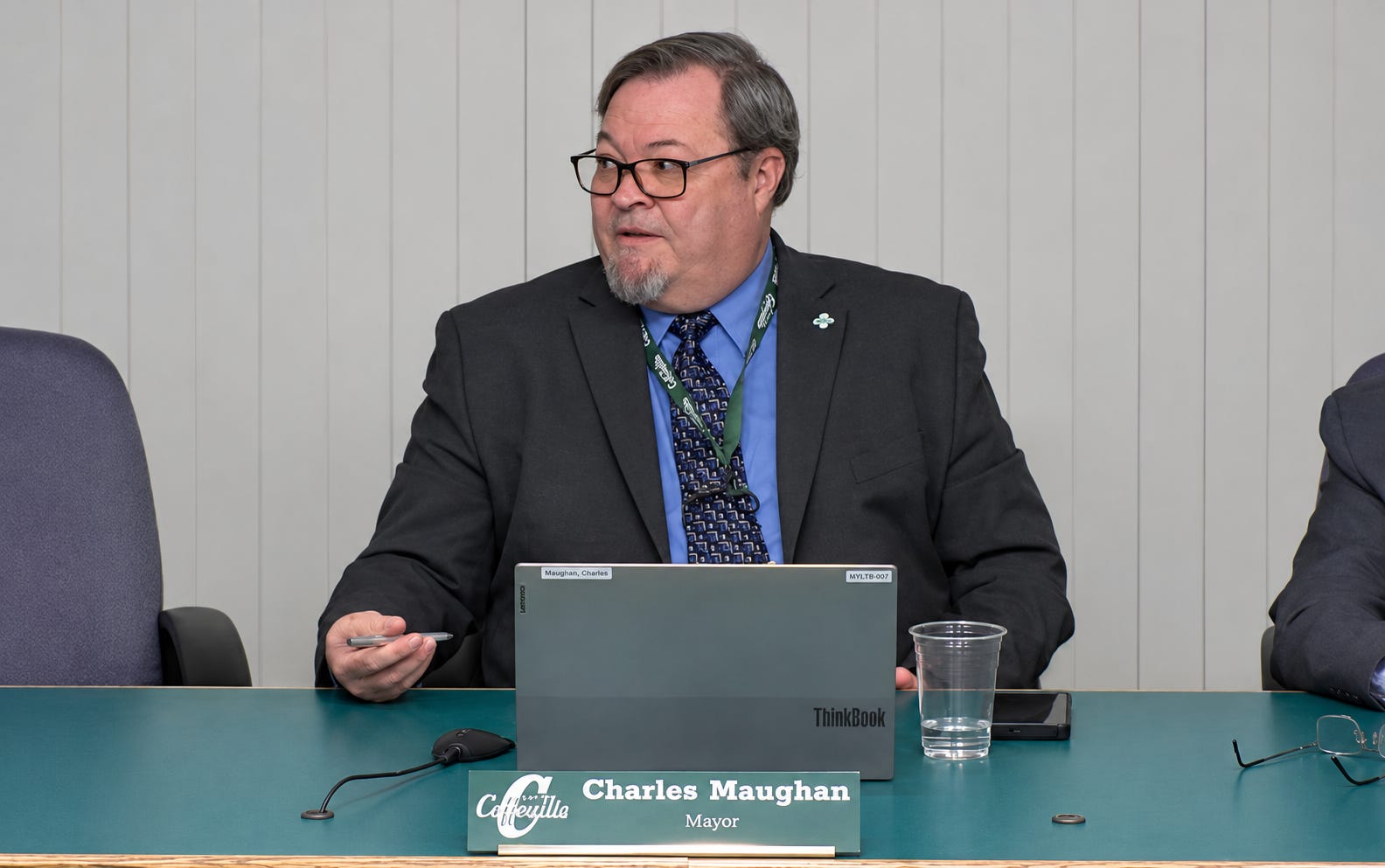
(Photo: Mayor Charles Maughan speaks at the November 16th Corvallis City Council Meeting)
He began with the city’s budget gap, then turned to hotly debated system development charges, or SDC fees, and the closure of Common Fields.
In both cases, he said the council had left a decision to its successors after having the opportunity to act.
Maughan said city staff brought forward options for addressing the budget gap, and councilors responded that they wanted more community outreach. He agreed. His frustration was with what happened when staff asked councilors what that outreach should look like and how long it should take.
“Council didn’t have an answer. They sat silently,” Maughan said. “Another work session later, staff asked again, ‘What is the time frame for this public outreach?’”
“It’s really the council’s job, our job, to engage the public,” he said. “But again, the council didn’t have an answer, and I had to put forth my idea, which really should have been all of yours. Because I’m not the decision-maker. You all are.”
Maughan was referring to the mayor’s role in our local government. He presides over city council meetings, but his only vote is when there is a need to break a tie.
Councilors representing individual wards vote on city policies, budgets, and fee changes.
Maughan said staff provided information and supported the outreach even when councilors weren’t clear about what they needed. The effort became a series of town halls that he said he mostly ran. Some councilors, he said, didn’t attend any.
After all of those town halls, the council voted to table the issue.
The budget gap issues are big decisions involving service cuts, new taxes, or a blend of both. It’s very possible that tabling a complex decision like that is fine for now.
He then brought up the fees affecting local businesses, an issue the council had heard about earlier in the evening during the community comments section.
“At that time, I urged the council to take some sort of action, to at least pause enforcement of those fees, to do something,” Maughan said. “Council decided again to push it off onto the next council. We always review our SDCs, and that’s fine, but meanwhile, as we learned tonight, a business is going to shut down that currently employs 40 employees. To me, that’s a failure on our part.”
Unlike the budget gap, it seems that tabling the SDC fee issue was not fine for now, as Common Fields cited the fees in their upcoming closure.
Maughan included himself in that criticism. “Although I’m not a councilor, I’m part of this council,” he said.
He initially counted two councilors-elect in the room, then spotted a third. He said he hoped they would revisit the outgoing council’s decisions and look at where it could have acted sooner.
“I’m hopeful for this next council,” he said. “I hope they do that, and I hope we have a bold council.”
“These are hard decisions,” Maughan said. “They impact everybody’s lives every day. But our inaction impacts those lives just as equally.”
Councilor Jan Napack
During council reports, Councilor Jan Napack addressed the prospect of a $30,000 charge. She raised the possibility of a loan or a surcharge on customers’ bills, then said her view of the fees depended on whether they were fair and comparable to those in other cities.
“As far as one last thing on delaying the food truck fees, that’s a tragedy if we end up asking $30,000,” Napack said. “You know, I understand that there’s a possibility of a loan. I wonder if there’s some sort of a surcharge that the owners can put on the bill to their customers.”
“I just don’t know, but if they are reasonable and they’re fair, and they are comparable to other cities, then that’s the way it is,” she said.
Public Works Director Jeff Blaine
Public Works Director Jeff Blaine pointed out a different way to view it. He said the city treats mobile food units that move around town differently from businesses that operate food truck pods. He said the mobile units can operate without incurring SDCs if they stay within the terms and time limits of their permits.
“SDCs are also not just being blindly assessed to all food carts that exist out in the community,” Blaine said. “That’s not something that’s happening right now.”
For Common Fields, Blaine said, the question was how many food truck spaces the business had approval to operate.
“Common Fields can operate within the limits that they have their land use approvals for and their permits approved for without being subject to any additional SDC.”
Blaine said. “If they want to expand their business beyond that, to incorporate more pod spaces, then they would pay the fees associated with that, just like anybody else.”
Councilor Jim Moorefield
Councilor Jim Moorefield asked about a claim he had seen in emails to the council that other communities don’t charge food truck pods transportation SDCs.
“One of the things being said in a lot of the emails is that other communities don’t have food truck, food pod transportation SDCs,” Moorefield said. “Could you clarify that?”
Blaine pointed to The Barn in Albany. He said the information he had received showed a higher transportation charge there.
“Yes, other communities do charge SDCs,” Blaine said. “Albany, again, in that example, has a higher SDC fee than Corvallis does for transportation fees related to a food pod. So, yeah, it’s not like Corvallis is an outlier there, alone on an island.”
This article was written by Jackson Hayes, a contributor to The Corvallis Inquirer. Feel free to send us your stories or articles to publish at: editor@corvallisnow.com
More recent stories:


→ Donate
We’ll still keep it ad-free and paywall-free even if you don’t. 100% of donations go to expanding local reporting, giving back to community causes, and minor operating expenses. Read more about our values and mission here.

Do you have a story for The Inquirer? Email us. We respond: editor@corvallisnow.com


Did Public Works Director Jeff Blaine actually provide examples of the SDC fees in Albany, or did he literally just say that he's heard that they're higher?