

Unless you’ve been living under a truck, you’ve probably heard about those pesky SDC fees. The City Council heard about it from more than a few speakers at the meeting tonight.
If you haven’t, Corvallis charges a one-time transportation system development charge (SDC fee) when it expects a new business or use of a property to generate additional traffic. For food trucks, a new truck could face a charge of about $15,300.
The City Council’s public comment section drew local business owners. Two who have been prominent in the public outcry are Jacob Oliver, owner of Common Fields, and Shalece Rains of the Sabores del Sur Food Cart Cooperative in Southtown.
Jacob Oliver told the City Council that the business could face about $30,000 in transportation system development charges for two of its six food truck spaces. He argued that assessing charges for individual trucks makes a food-cart pod responsible for far more than a single restaurant.
“Current SDC fees for food trucks are cost prohibitive and do not support the intended economic growth of Corvallis.” he also pointed out.
Oliver also said the fees have stalled other food-truck projects and are pushing businesses to consider neighboring cities. He asked the council to pause the SDC fee application to food trucks while it works toward a more reasonable approach.
“Common Fields and other small businesses that have been affected by this do not have the kind of time it will take to make these changes,” he said.
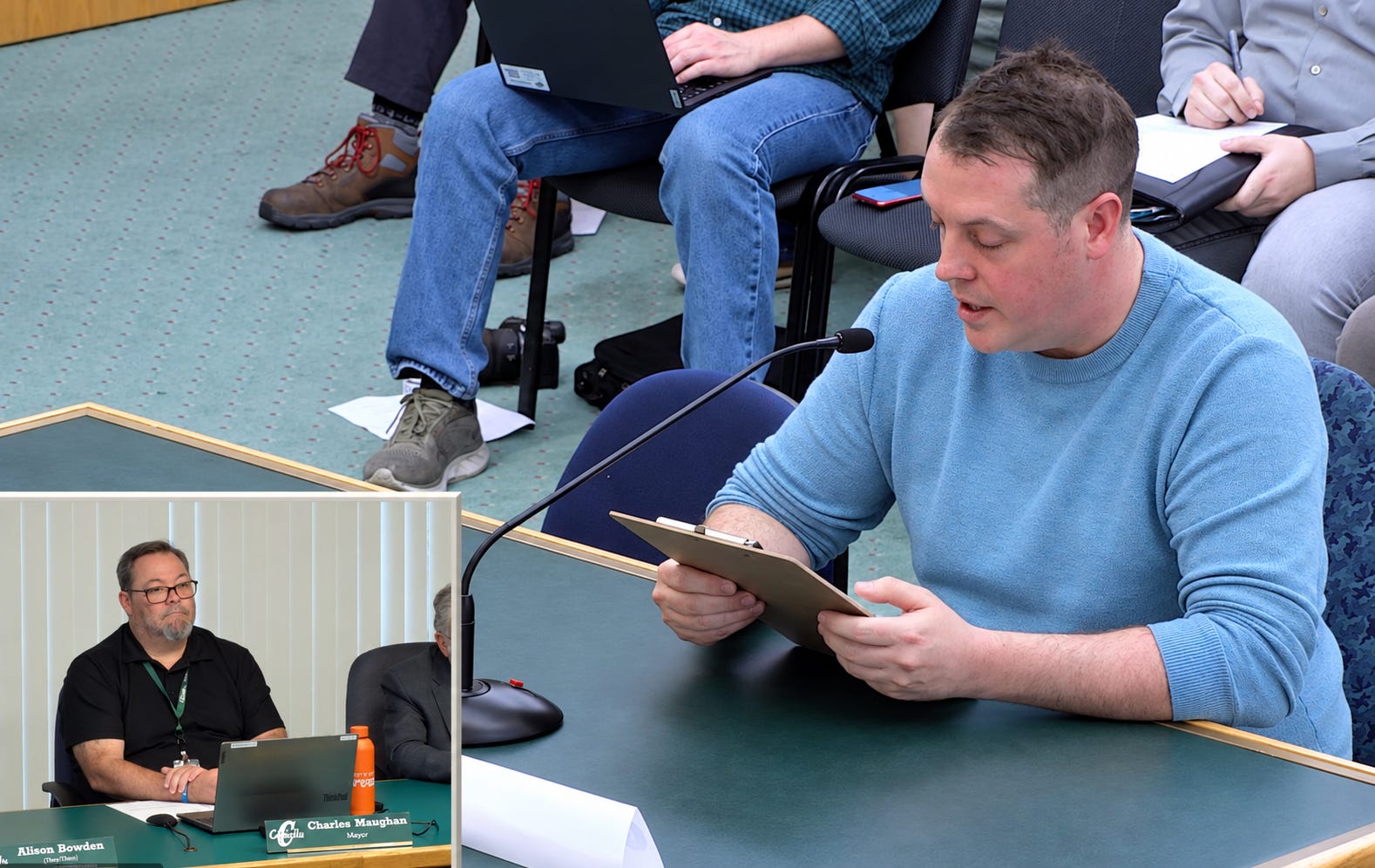
(Photo: Jacob Oliver speaks at the September 22, Corvallis City Council meeting)
Shalece Rains, president of the Sabores del Sur Food Cart Cooperative, said her group received a grant in 2024 to establish a food-cart pod in South Corvallis. Rains said the combined cost of required site improvements and SDCs puts it in jeopardy.
“When you put the cost of site improvements required by ordinance, plus the SDC fees, against a reasonable estimate of annual food-cart earnings, it’s a tough business case,” she said.
Rains urged councilors to consider how the charges affect small businesses and to make sure the city’s formulas are appropriately sized. Her goal, she said, is a place where businesses can thrive, the community benefits, and the city has the resources to maintain essential infrastructure.
Cody Hutzman, owner of the Bodhi Group, also spoke to the City Council about the SDC fees and their effect on the recently closed Papacitos.
Cody told the council that he bought a $30,000 food truck last May to help Papacitos, his struggling Southtown restaurant. He said he then learned that operating the truck on the restaurant’s private property would trigger an additional city charge of about $17,800, nearly 60% of the truck’s purchase price, “before we could even serve a single meal from it.”
Hutzman said the restaurant already had customers coming to the site, but he was told that current activity would not be recognized in the fee calculation. He said hiring a traffic engineer to seek a different calculation would have meant more expense and delay, with no guarantee of a lower charge.
The truck remains unused, and Papacito’s has since closed. “There were several financial challenges behind that closure,” he said, “but this fee prevented us from trying something that we had already invested in to help that business and location succeed.”
Hutzman asked the council to provide immediate relief and find an affordable way for small businesses to account for activity already occurring at a site. “For Papacitos, that opportunity has passed,” he said. “For the businesses represented here tonight, there is still time.”
Time seemed to be a common theme amongst speakers. In terms of urgency, and how much longer, or at what capacity, businesses can continue to operate, expand, and start up, with these fees in place.
Full transcripts below.
This article was written by Jesse Grant, a contributor to The Corvallis Inquirer. Feel free to send us your stories or articles to publish at: editor@corvallisnow.com
-Full Transcripts-
Jacob Oliver, Common Fields
Mayor and Council, thank you for taking the time to listen to me today. I want to start by thanking those of you who met with me before this meeting to better understand these issues. I think that goes a long way toward showing your dedication to supporting Corvallis.
I think we’re all in agreement that the current SDC fees for food trucks are cost prohibitive and do not support the intended economic growth of Corvallis. I know the problems surrounding SDC fees are complex and cannot be fixed overnight. After spending the past few weeks researching them, I see the issue as having two parts.
The first issue, and the reason I started looking into food-truck SDCs, is the recent discovery that Common Fields, an established business, could be responsible for SDC fees for two of our six food-truck spaces, totaling around $30,000. Under the current approach, food-truck pods are assessed fees for individual trucks rather than as a single business. That could leave a pod responsible for far more in SDC fees than a restaurant. According to the current calculations, Common Fields’ six trucks would be comparable to 7.5 restaurants.
I also do not think the city should collect a new transportation SDC from a business that has been established for six years. I would argue that adding trucks to an existing pod, without adding infrastructure or expanding the property, is not new development and should not trigger additional SDCs.
The bigger picture is that these food-truck SDCs have paused development of multiple food-truck pods in Corvallis, contributed to a restaurant going out of business, and halted a food-truck cooperative that received grant funding to operate in Southtown and address a growing food desert. We’re already seeing businesses choose neighboring cities instead of putting down roots in Corvallis.
Since these fees took effect a year ago, not a single food-truck business has chosen to open and pay them. Instead, businesses are in limbo or moving to other cities. I think that tells us the fees are not economically viable.
I understand that making equitable and reasonable changes takes time. Unfortunately, Common Fields and other affected small businesses do not have that kind of time. That’s why I’m asking you to pause the application of these SDCs to food trucks until a more reasonable approach can be determined.
I think everyone on this council believes in supporting economic growth, and these fees stifle that growth. Please vote to save Common Fields and the future of food trucks. Thank you.
Shalece Rains, Sabores del Sur Food Cart Cooperative
Good evening, councilors. My name is Shalece Rains. I’m a Ward 3 resident, president of Sabores del Sur Food Cart Cooperative, and co-owner of [food cart name to verify], a food cart currently operating in South Corvallis.
You may know that the group that eventually became Sabores del Sur was awarded a grant in 2024 to establish a food-cart pod in Southtown. We knew finding the right property and partnerships would be hard. We knew ordinances would have to change for us to have a chance. We did not learn until this year that we would face another challenge: enormous SDC fees applied to the master site permit holder. We hope this challenge is not insurmountable.
While the new mobile-food-unit ordinance removed a major obstacle to our project, the required site improvements carry a hefty price tag. When you compare the cost of those improvements and the SDC fees with a reasonable estimate of annual food-cart earnings, it’s a tough business case. As Jacob said, most people are choosing not to take it on.
That math puts our project in jeopardy and makes it less likely that others will attempt the kinds of ventures that bring vibrancy to communities where it’s most needed.
During this journey, several people have reached out to me about food carts and food-cart pods in Corvallis. Recently, someone with great potential asked me, “How are we expected to make it?” Sadly, the best model right now may be to stay mobile. That is not ideal for businesses or for the community.
We want to do more than serve food, delicious as it is. We have something more to offer Corvallis. Placemaking can seem intangible, with impacts that are difficult to measure, but it is vital. Our vision is to create a bright spot: a comfortable place for this community.
I ask you to carefully consider the foreseeable impacts of this practice and ensure the formulas are appropriately sized, so thoughtful development can move forward while maintaining the infrastructure we need.
I’m a transplant to Corvallis. This is an amazing place, and I see no reason we cannot create an environment where businesses thrive, the community benefits from our innovations, and the city has the resources to keep us safe. Thank you.
Cody Hutzman, owner of the Bodhi Group
Good evening, Mayor and Councilors. My name is Cody Hutzman, and I own the Bodhi Group. We currently employ 75 people who live in Benton County, including employees at Bodhi Cafe and Bodhi Bistro here in Corvallis.
I’m here because I’ve personally experienced what an SDC fee can mean for a small business. Last May, we purchased a $30,000 food truck for Papasito’s, our Southtown restaurant. The location was struggling, and we hoped the truck would bring more people through the door and give the business a better chance.
We quickly learned that operating the food truck on private property at an established restaurant would require an additional city charge of approximately $17,800. That was nearly 60% of what we paid for the truck itself, before we could serve a single meal from it.
We already had customers coming to that address, so we asked whether that existing traffic would be recognized in the calculation. We were told no. The alternative presented to us was to hire a traffic engineer to support a different calculation. We were told the fee was based on a national database rather than a survey of the site. That meant spending more money and waiting longer, without knowing whether the fee would change significantly.
Today, the truck sits unused, and the Southtown restaurant has closed. Several financial challenges contributed to that closure, but this fee prevented us from trying something we had already invested in to help the business succeed. That is the consequence I want the council to understand.
I recognize that roads, sidewalks and public infrastructure cost money. Small businesses depend on them, and we should all contribute fairly. But a fair charge needs to reflect the additional demand a project actually creates, including the customers and activity already at the site. The process for demonstrating that should also be affordable for a small operator.
Food trucks give cooks and entrepreneurs a chance to build something of their own. They bring jobs, variety and gathering places to neighborhoods like Southtown. A fee this large can stop that opportunity before it starts.
I’m asking the council to provide immediate relief while it reviews these charges, direct staff to bring back an affordable fee structure, and establish a practical way to recognize existing site activity without requiring an expensive private study. Please involve affected business owners directly in that work.
For Papasito’s, that opportunity has passed. For the businesses represented here tonight, there is still time. Thank you.
→ Donate
We’ll still keep it ad-free and paywall-free even if you don’t. 100% of donations go to expanding local reporting, giving back to community causes, and minor operating expenses. Read more about our values and mission here.

Do you have a story for The Inquirer? Email: editor@corvallisnow.com


