

Benton County commissioners just adopted a resolution that opposes proposed laws that would shield fossil fuel companies from climate-related lawsuits.
County commissioners Gabe Shepherd and Pat Malone approved Resolution R2026-016 on a 2-0 vote on September 1st. Shepherd made the motion, and Malone seconded it.

(Photo: Benton County Commissioner Gabe Shepherd)
It’s a bit complicated, but not overly complicated, and ties into the Stop Climate Shakedowns Act of 2026.
The resolution states that Benton County supports the right of cities, counties, tribes, and states to sue fossil-fuel companies over deceptive conduct and the public costs associated with climate change. It also opposes federal or state legislation that would grant those companies immunity or force cases to be dismissed.
In short, the heart of the dispute is whether local governments should be allowed to seek compensation from energy companies for damage allegedly connected to their products or business practices.
“This resolution came to my attention as a way to address and push back on some federal bills that are being proposed that would essentially indemnify fossil fuel companies from the consequences of their long-held knowledge that their product is causing human-caused climate change,” Shepherd said during the meeting.
Shepherd described the resolution as part of a grassroots effort among local governments to draw the attention of members of Congress.
“There’s a grassroots movement to get local governments to push back, get their congressional delegation to highlight this and make sure that this doesn’t gain any traction in the federal delegation,” he said. This resolution specifically objects to legislation titled the “Stop Climate Shakedowns Act of 2026.”
Opponents of the Stop Climate Shakedowns Act of 2026 believe the act would give fossil-fuel companies legal protection and prevent communities from seeking compensation for costs associated with their climate impacts.
The American Petroleum Institute obviously supports that federal legislation. In an April statement, API Senior Vice President and General Counsel Ryan Meyers characterized the cases as an attempt to impose retroactive penalties on companies that legally supplied energy.
“These efforts to retroactively penalize companies for lawfully meeting consumer demand are misguided and counterproductive,” Meyers said.
Benton County’s resolution takes the opposite position. It says governments should retain access to courts and other legal remedies when they believe companies have contributed to climate damage or have misled the public.
The issue is not theoretical here in Oregon. Multnomah County sued oil, coal, and industry organizations in 2023, alleging their historical pollution and deceptive conduct contributed to the deadly 2021 Pacific Northwest heat dome.
That case seeks $50 million for past damages, $1.5 billion for future damages, and an estimated $50 billion abatement fund for public-health and infrastructure measures. The case is currently in active litigation in Multnomah County Circuit Court under case number 23CV25164.
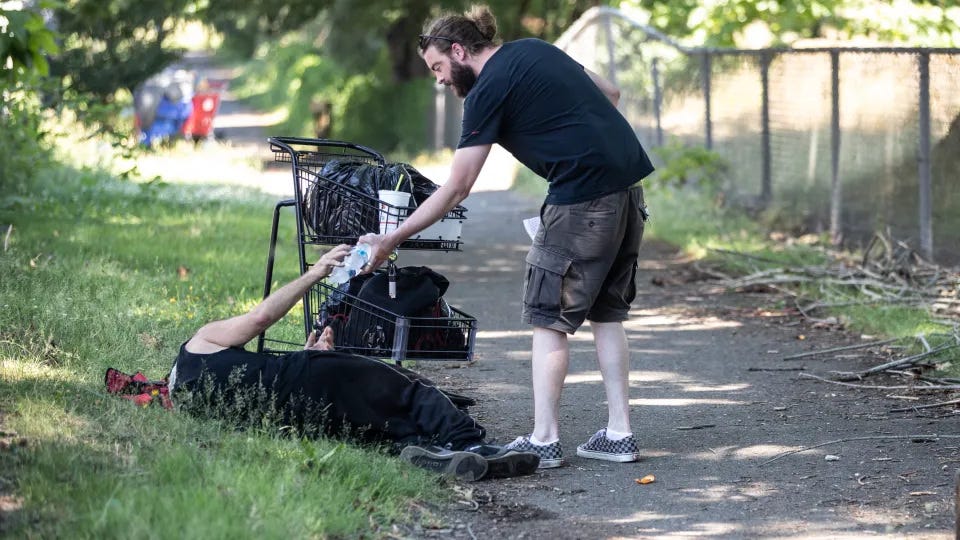
Photo: An outreach worker distributes water to a person experiencing homelessness during the June 2021 heat dome. Multnomah County’s ongoing lawsuit alleges fossil-fuel companies bear responsibility for costs associated with the deadly event. Photo courtesy of Multnomah County
Malone described Benton County’s resolution as largely a statement of principle, adding, “I think this resolution fits in with Benton County values.”
He pointed to County investments in energy-efficient buildings, alternative transportation, bicycle and pedestrian facilities, hybrid and electric vehicles, and efforts to track government fuel and electricity use.
Shepherd said County staff had added local language to the resolution explaining those priorities. “Staff helped me by plugging in some Benton County-specific values about why we in Benton County value sustainability,” he said.
The vote came a day after commissioners held a closed executive session with County Counsel under an Oregon law allowing private discussions about litigation. The County did not publicly identify the case discussed during that session.
The timing is interesting, but the available records do not establish any connection between the executive session and climate litigation.
This is a case of a county looking out for its people, starting to build a framework, and taking a stance.
This article was written by Jesse Grant, a contributor to The Corvallis Inquirer. Feel free to send us your stories or articles to publish at: editor@corvallisnow.com
More recent stories:


→ Donate
We’ll still keep it ad-free and paywall-free even if you don’t. 100% of donations go to expanding local reporting, giving back to community causes, and minor operating expenses. Read more about our values and mission here.

Do you have a story for The Inquirer? Email: editor@corvallisnow.com


