

When Ritu Bhardwaj returned to Corvallis on December 6th, 2024, she believed she had a legal right to enter the home she shared with her husband
Hours later, she was standing in her pajamas, barefoot and handcuffed.
By the end of the night, after being strip-searched, she was in jail… where she was to remain for three days… accused of burglarizing a house where she was legally married to the occupant. Her husband.
No charges were filed.
This story is based on allegations, not conclusions, and those allegations are at the center of a 27-page federal civil-rights lawsuit filed on November 5th, 2026, against the City of Corvallis, Police Officer Nathan Diebel, and Bhardwaj’s now ex-husband, Ritwik Nath.
There are a lot of facets to this story. More than one would think. The only place we have to start is the complaint.
The complaint accuses the defendants of conduct that resulted in Ritu Bhardwaj’s arrest and a three-day incarceration that followed. Despite attempts to explain that she was legally entitled to be inside the residence.
In the end… prosecutors declined to file criminal charges. A Corvallis police sergeant also rescinded a trespass notice issued against her.
This lawsuit, like a lot of civil lawsuits, seeks compensatory and punitive damages. No specific dollar amount has yet been identified.
This lawsuit, like many civil lawsuits, contains allegations that have yet to be established in court. The complaint presents Bhardwaj’s account of events, and the court has yet to make findings of fact.
The marriage began thousands of miles away
Bhardwaj and one of the defendants, Ritwik Nath, met through an arranged-marriage dating website while she was living in India and he was living in Corvallis.
They married on March 3rd, 2022.
After a lengthy immigration process, Bhardwaj arrived in Corvallis on July 22nd, 2024, to begin married life with Nath at their residence on Southwest Stanford Street.

(Photo: The building identified in the lawsuit on Southwest Stanford Street/The Corvallis Inquirer)
The arrangement deteriorated quickly. On August 6th, less than three weeks after arriving, Bhardwaj returned to India because of illness and personal distress that she attributed to “restrictions on her living conditions”.
From India, she attempted to contact her husband repeatedly by telephone and text message.
The complaint alleges that Nath largely ignored those messages. On September 10th, he responded that it was not an appropriate time for her to return.
Just two days later, unannounced to Bhardwaj, Nath filed a petition for dissolution of their marriage in Benton County Circuit Court.
Bhardwaj alleges she was unaware of the divorce filing until September 19th. On September 26th, Nath emailed her that he wanted to end their relationship, but did not mention the pending divorce proceeding.
During this time window, Bhardwaj was attempting to retrieve her permanent resident card, commonly called a green card, which had been mailed to their residence here in Corvallis.
She requested a scanned copy from Nath on September 22nd and again on September 29th. Neither request received a response.
By mid-October, she had enlisted the assistance of attorney Andrew Long of Legal Aid in Albany to recover the document.
She finally received her green card on November 18th, 2024.
She asked police before coming home
Before returning to Corvallis, Bhardwaj contacted the Corvallis Police Department to ask whether she could legally enter the residence.
Between November 13th and December 5th, 2024, she communicated with Officer Andrew Christoson through telephone calls and emails.
On November 14th, Christoson advised her in writing that she “may enter any property to which [she has] a lawful right,” this according to the complaint.
For Bhardwaj, the correspondence was interpreted as reassurance.
On December 5th, she sent Christoson an email thanking him for his assistance.
“After talking to you, I got courage to come to Corvallis, Oregon,” she responded. She then told him she expected to arrive the following evening, December 6th, around 5:30 pm.
When she reached the house, Nath was not home. And she was never given the key, so she hired a locksmith to let her inside.
Eventually, she went upstairs and fell asleep.
An intruder in the bedroom
According to the plaintiff, around 10 pm, Nath returned to the residence and called the police to report an intruder. He told the dispatcher that he believed the intruder was his ex-wife.
Officers were dispatched, he told the arriving officer, Nathan Diebel, that he and Bhardwaj had divorced on September 16th, 2024.
According to the lawsuit. Their divorce was not finalized until June 29th, 2026. Almost 2 years later.
Officer Diebel entered the house with his pistol drawn in what the complaint describes as a low-ready position. So not pointed. He proceeded upstairs, opened a bedroom door, and discovered Bhardwaj lying in bed.
The lawsuit alleges that Diebel observed no evidence of a burglary or disturbance. Nevertheless, he continued holding his firearm and ordered Bhardwaj to stand.
She complied.

Another responding officer, identified as Officer Berry, placed her in handcuffs and escorted her outside barefoot and wearing pajamas.
As she was led past Nath, Bhardwaj pleaded with him to intervene.
“Why don’t you tell them I’m your wife?” she asked, according to the complaint.
Nath did not intervene.
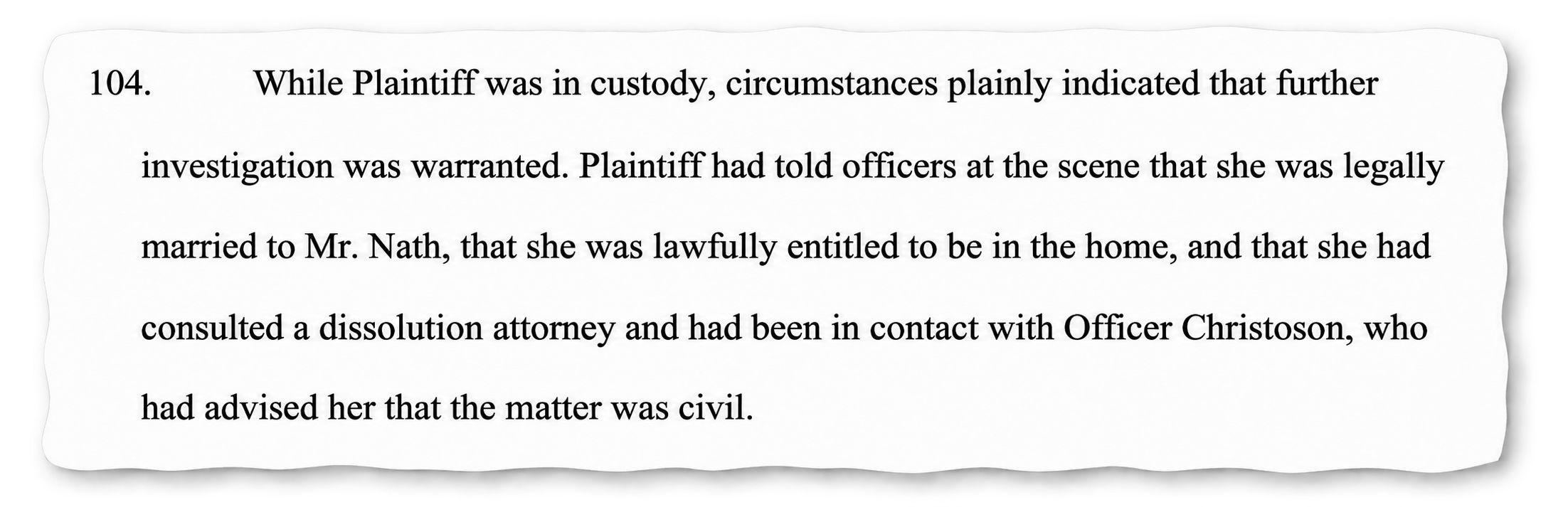
Bhardwaj repeatedly told officers that she and Nath were still legally married and that she had consulted an attorney about her right to enter the home. She also explained that she had contacted the Corvallis PD before returning.
While seated in the patrol car, she spoke through a Hindi interpreter and told officers she had documents establishing her marital status.
Diebel, reportedly, cited burglary and theft as grounds for the arrest.
Burglary and Theft?
Yes. According to the lawsuit, the theft allegation was based on Bhardwaj’s use of electricity, heat, and other utilities during the few hours she spent inside the residence.
Take what you want from that. It’s what the complaint says.
She was transported to jail.
Three days behind bars
Bhardwaj remained incarcerated for three days.
During the booking, she was strip-searched, an experience that the complaint describes as “especially humiliating and distressing to her as an Indian woman.”
The lawsuit states that, while she remained in custody, Diebel became aware of her earlier correspondence with Officer Christoson, including the advice concerning her legal right to enter the residence.
The complaint states Diebel failed to take steps to secure her release or communicate the information to someone who could.
On December 9th, 2024, Deputy District Attorney Kyle Haney informed Corvallis Police Sergeant Roach that prosecutors would not file charges because the matter was civil and Bhardwaj and Nath were legally married. This, according to the lawsuit.
That very same day, Roach rescinded the trespass notice Diebel had issued against Bhardwaj.
There is more. The complaint also attributes a written observation to Roach after he reviewed dispatch information: “Officers should not make trespassing/burglary arrests until the divorce was finalized.”
Bhardwaj was released without criminal charges.
Three defendants
The federal complaint includes 12 claims involving malicious prosecution, emotional distress, negligence, abuse of process, constitutional violations, false arrest, and false imprisonment.
Five of those claims are directed at Nath, accusing him of knowingly misrepresenting the couple’s marital status to police… and using the criminal justice system to remove Bhardwaj from the home.
Three federal constitutional claims are directed at Officer Diebel individually. They allege an unreasonable arrest without probable cause, unlawful continued detention, and excessive force involving his firearm.
The complaint also names the City of Corvallis, alleging the department failed to adequately train and supervise officers handling disputes that involved marital residences.
Bhardwaj’s attorney, Rachel Menashe of Bend, argues that officers should have independently investigated the conflicting accounts rather than relying only on Nath’s statements.
The complaint seeks compensation for loss of liberty, emotional distress, medical and mental-health expenses, relocation costs, and other losses. It also requests punitive damages against Nath and Diebel individually, along with attorney fees.
Like we said earlier, no dollar amount has been tied to those compensations, yet.
Officer Diebel was previously cleared in a separate lawsuit
Maybe that name rings a bell for you. Diebel was previously named in another civil lawsuit involving a disputed arrest. He was cleared. By the justice system. By the courts.
In May 2024, Micky Garus filed a lawsuit on behalf of his teenage son, Noah Garus. The lawsuit stated Corvallis officers falsely arrested the 16-year-old on suspicion of driving under the influence and failed to recognize that he was experiencing a diabetic medical emergency.
The lawsuit sought $803,300 in damages.
We pulled some reporting by The Oregonian and the Corvallis Gazette-Times in this particular case. It’s “courts ’n’ sports,” and both are more versed to report on these particular things than we are.
According to The Oregonian’s account of the civil complaint, Garus’s blood sugar testing equipment was unavailable after police impounded the car.
The complaint separately alleged that his needles had been tossed in the trash and had to be retrieved so he could receive his medication. His breath test registered 0.00%, and his urine test found no intoxicating substances.
Attorneys for the city denied the allegations and maintained that officers had probable cause for the arrest.
The case proceeded to a jury trial in Benton County Circuit Court. The jury ruled in favor of Diebel and the City of Corvallis. It found that the defendants were not liable, according to reporting by the Corvallis Gazette-Times.
That verdict concerned a separate incident and does not establish the merits of Bhardwaj’s allegations.
What happens next?
Probably a lot. The new federal case, Bhardwaj v. Corvallis et al., is assigned to Magistrate Judge Amy E. Potter in the U.S. District Court for the District of Oregon.
Discovery is scheduled to conclude on March 5th, 2027, with additional pretrial deadlines in April. Those most likely will change.
Now for the standard “this lawsuit raises questions about” paragraph.
How Corvallis police handle competing claims to a marital residence, what information officers are expected to review before making an arrest, and what responsibility they have to act when potentially exculpatory evidence emerges after someone has been jailed.
This was an international marriage arranged online, with police communications, a green card, an illness, a locksmith, a drawn gun, pajamas, bare feet, a strip search, three days in jail, no charges filed, and a sh*tload of misunderstandings, interpretations, and gray areas that would be hard for any court, lawyer, plaintiff, defendant, or judge to conclude with 100% certainty.
Editor’s note: Three days in jail without charges is not necessarily unlawful in Oregon, especially over a weekend. Bhardwaj was arrested on a Friday. But a detention can still violate someone's rights if the initial arrest lacked probable cause or if continued detention was unjustified.
This reporting is based on the central allegations in Bhardwaj's federal lawsuit. These are just allegations for a court or jury to decide. In no way are the defendants guilty, or Bhardwaj’s claims justified until that decision.
This article was written by Brian Lindensmith and edited by Derek S., contributors to The Corvallis Inquirer. Feel free to send us your stories or articles to publish at: editor@corvallisnow.com
More recent stories:


→ Donate
We’ll still keep it ad-free and paywall-free even if you don’t. 100% of donations go to expanding local reporting, giving back to community causes, and minor operating expenses. Read more about our values and mission here.

Do you have a story for The Inquirer? Email us. We respond: editor@corvallisnow.com


