
Why rely on opinion? Why argue over what was done right or wrong? There are no excuses, but there is math (guerilla math), and it can help point us to a conclusion.
The effort to recall members of the Corvallis School Board officially came to an end April 6, 2026, after organizers failed to submit any signature sheets before the deadline.
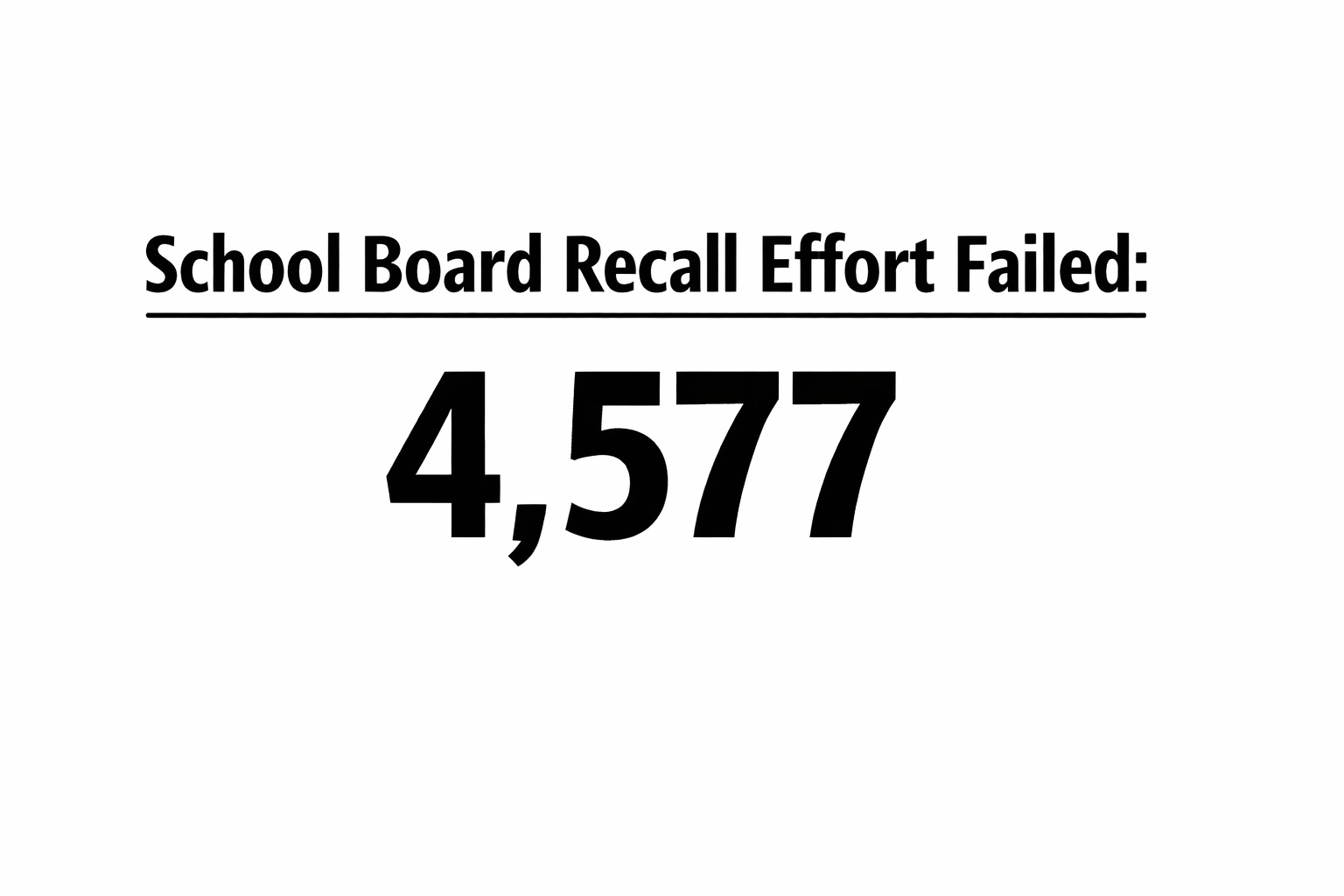
To qualify for the ballot, the recall effort required 4,577 valid signatures. The campaign fell short… and even in a best-case scenario, the numbers suggest the movement never gained broad traction in the community.
Taking into account the city of Corvallis (and not the entire school district boundary) Corvallis has an estimated population of 60,400. But a large portion of that number comes from students at Oregon State University, which enrolls roughly 25,374 students (corvallisoregon.gov).
For the sake of understanding local engagement, let’s remove the student population and say none of them signed the petition. Saying none of them signed the petition (which surely some did) gives a margin of error in favor of the recall effort. Because surely some did sign. So 35,026 non-student residents
Let’s assume that only one-third of residents were aware of the recall effort. We bet you’re thinking that is low. In a small town where the issue circulated widely for months through media, word of mouth, parents, and petition drives at local businesses. But let’s stay conservative. One-third awareness actually favors the recall effort in this math (if there was more awareness than one-third, that means there should have been more possible signatures). The number of informed residents comes to 11,675 people.
Let’s say organizers had come just one signature short (another number that favors the recall effort), so they had 4,576 signatures.
That’s about 39% of the population, who knew about the recall, who signed the petition, and we are assuming it fell just ONE signature short (it didn’t), that only ONE-THIRD of the population knew about it (more did), and that NO students signed (some did). 39%.
If you took the total population. And not favor the recall signing effort in the data. It’s 7.5%.
Recalling the school board was not the prevailing view among Corvallis residents. Each signature represents more than ink on paper, it represents a vote, a voice, and participation in a democratic process. That process played out.
Whether through action or inaction, the community spoke. In a time when civic trust can feel uncertain, it’s worth remembering that the ability to take part, to organize, to sign (or not sign), is itself something to be grateful for.
Congrats to Save Corvallis Schools for raising awareness. Congrats to the school board for maintaining their roles. And congrats to the people of our town for having a voice, an opinion, and a safe space to pursue them. Let’s hope our students can learn from this process… and carry it forward in life.
Do you have a story for The Inquirer? Email: editor@corvallisnow.com


→ Support us
We’ll keep it ad-free even if you don’t.


Did you talk to anyone involved in the effort about why they think the petition might have not gotten the results they wanted? Did they have any insight into the views or attitudes of the community members about the recall?