

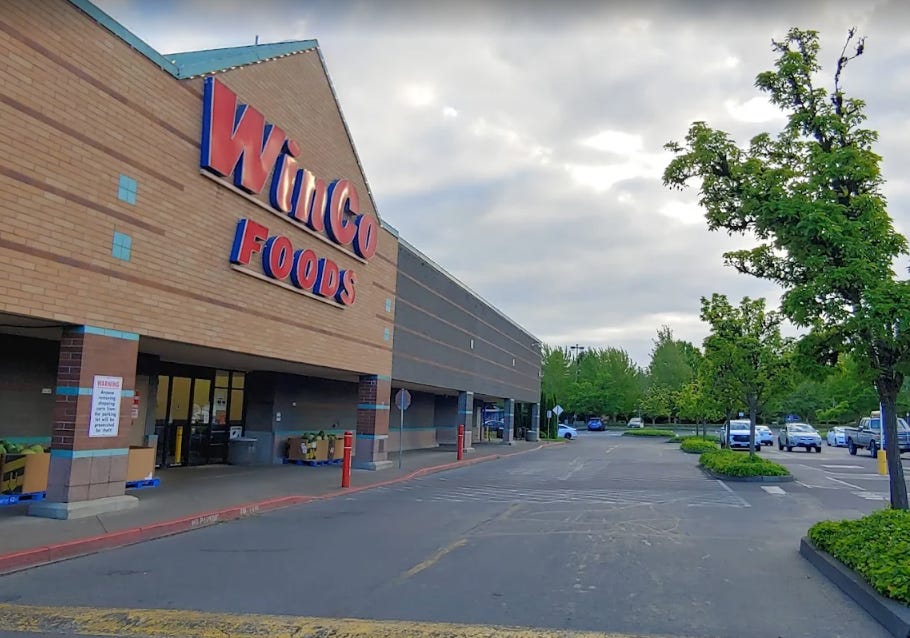
The WinCo on Northwest Kings Boulevard looks just like a normal large grocery store. Busy parking lot. Bulk bins. Families loading carts with groceries. Employees stocking shelves. Lines (always lines) at the register. But it’s also one of the most unusual labor and ownership experiments in retail.
The Corvallis WinCo store has been highlighted as one of the strongest examples of employee ownership success in the country. The roughly 130 employees at the WinCo on Kings collectively accumulated retirement wealth estimated at over $100 million through the company’s Employee Stock Ownership Plan, commonly known as an ESOP.
A few longtime employees have become millionaires while working ordinary grocery store jobs. Think about that. The idea almost sounds impossible in modern retail, where profits and margins are continually squeezed at the expense of employees.
Unlike a normal publicly traded company, where outside investors buy shares to own portions of the company, WinCo is primarily employee-owned through an ESOP. Eligible workers receive company-funded retirement contributions tied to ownership shares in the business.
Employees do not buy the stock directly with their own money. Instead, the company contributes to the ownership accounts on their behalf. We got a copy of WinCo’s benefits summary, and the details are outlined below:
“Employees that have attained age 19, have been employed for six months, and have worked at least 500 hours during those six months will become eligible to participate in the ESOP Plan. Participants receive one year of vesting after being paid 1,000 hours in a Plan Year. Vesting increases by 20% each Plan Year participants are paid 1,000 hours until 100% vesting is reached (participants typically obtain 100% vesting after six years of service).”
Over time, shares accumulate inside the employee’s retirement account. After a vesting period (about 6 years), those shares become fully theirs… to do what they want with. The system rewards longevity. The longer an employee stays, the more ownership they accumulate. Think compound interest.
Our store became nationally notable because many employees there had been with the company for decades during WinCo’s major expansion years.
Employees who joined early participated in the company before much of its growth occurred. As WinCo expanded and added more locations, the value of employee ownership accounts surged alongside the company itself.
An ESOP is not easy money. It works more like long-term investing. The people who saw the largest gains were often those who entered the company early, stayed for decades, continued accumulating ownership during expansion years, and benefited from compounding growth over time.
It resembles holding stock in a growing company for 20 or 30 years rather than chasing a quick payout. The millionaire employee headlines at our WinCo can create unrealistic expectations if taken out of context.
The biggest wealth stories largely came from workers who entered the company before the massive expansion started. Once a company matures, future returns may slow compared to earlier explosive growth periods.
This does not mean the ESOP lacks value today. Even without the “get in early” future millionaire outcomes, WinCo’s ESOP can still provide retirement stability that is increasingly rare.
The store on Kings challenges assumptions about low-wage retail employment. The workers becoming wealthy were not Silicon Valley executives or startup founders. They were grocery clerks, stockers, backroom warehouse workers, and cashiers.
Our WinCo is home to one of the most successful examples of the employee ownership model that exists today. We just wish they would take credit cards. Even for a small fee. Rumor has it they are going to start that soon… to quote a nice lady working at the register last week. Maybe she is a millionaire as well.
Do you have a story for The Inquirer? Email: editor@corvallisnow.com


→ Support us
We’ll keep it ad-free even if you don’t.

