

We have a weird habit of hiding things in plain sight here in town.
You can drive past industrial buildings, research labs, and office spaces without thinking much about what is happening inside them. We keep seeing that office park sign “Nutsac World Headquarters” off of Grant, although it’s not as interesting as the name would presume. Looked into it.
But every once in a while, something grows without notice. That brings us to Phosio who recently made headlines in the Portland Business Journal for landing $4 million in funding.
(www.phosio.com)
Phosio’s headquarters are located just off Circle, and the company may be working on one of the biggest future bets in tech. Smart glasses. The kind people may eventually wear everyday instead of pulling phones out of their pockets. And recently, the tiny startup located here got another major sign that the tech world is paying attention.
Former Meta Vice President of Research Joe O’Keeffe joined the company as executive chairman. That is not a small hire. Meta has spent billions trying to build the future of augmented reality and AI-integrated wearable devices. The company’s Reality Labs division has become one of the most aggressive players in the global race toward smart glasses and AR systems.
So when a former Meta research executive joins a small Corvallis materials startup, it means something. It suggests the technology may be more serious than most people realize.
Phosio is not a big corporation, but more of a research lab. No giant downtown office. No Silicon Valley branding campaign. Just a small deep-tech company operating out of research facilities near HP’s longtime footprint in town.
Internally, the company is tackling problems that the largest tech companies in the world are currently struggling to solve. How do you make smart glasses thin enough to look normal? How do you make displays brighter without overheating? How do you reduce energy use while keeping image quality high? How do you manufacture advanced optical materials cheaply enough to scale globally?
Those tiny material science problems may ultimately determine whether AI glasses become mainstream, or remain an expensive niche product.
That is where Phosio comes in.
The company was founded by Omid Sadeghi, who came to Oregon State University for a PhD in materials chemistry before launching the startup in Corvallis. The work centers around advanced thin-film optical materials and nano-scale manufacturing systems that could eventually be used in augmented reality displays, semiconductor manufacturing, lidar systems (think self-driving technology), and wearable AI devices.
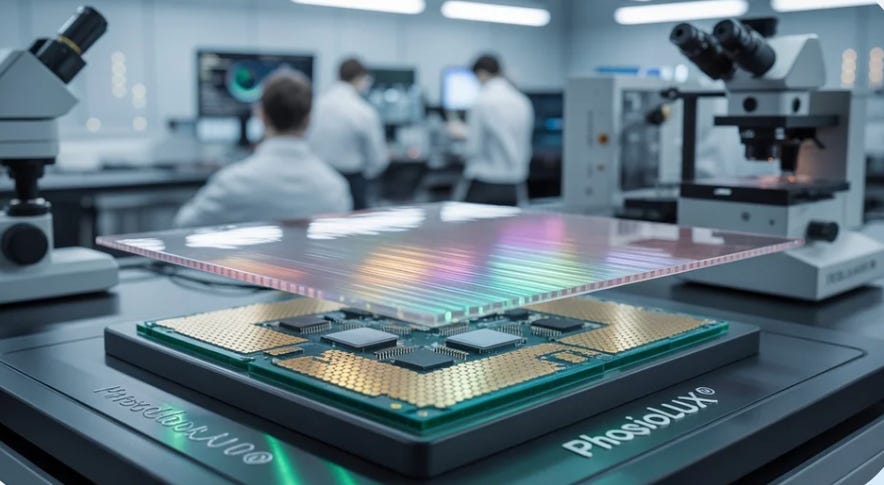
The company’s platform, called PhosioLux, focuses on high-performance optical coatings that can be manufactured at lower temperatures than traditional methods.
Phosio has gone through years of failed experiments. Funding uncertainty. Investor meetings. Research setbacks. At one point, the company reportedly endured roughly 500 failed experiments before achieving a major breakthrough.
Sadeghi recently reflected on the company’s journey after closing Phosio’s seed funding round, saying the startup’s growth was proof that “it takes a village.”
The comment highlights how deeply connected the company’s success has been to Oregon’s startup and research ecosystem. Early support reportedly came from Business Oregon, followed by organizations like Oregon Nanoscience and Microtechnologies Institute (ONAMI) and Oregon Entrepreneurs Network’s Angel Oregon Technology program. Those early investments and mentorship opportunities eventually helped Phosio attract additional backing from firms including Elevate Capital and TiE Oregon.
Phosio’s story is not just about one startup. It is also about the network of universities, investors, incubators, and local innovation programs trying to build a tech economy in places like Corvallis and Oregon, instead of Silicon Valley.
Unlike many startups that immediately leave smaller cities, Phosio appears committed to building in Oregon. The company is now planning a pilot manufacturing facility. Whether that facility will remain in Corvallis is still in question, but we hope it stays here at its birthplace.
Oregon State University continues feeding talent into robotics, semiconductors, materials science, and AI research. Agility Robotics emerged from the same ecosystem before becoming nationally known for humanoid robots.
Now Phosio here in Corvallis may be joining that list. Maybe Corvallis will be the next Silicon Forest.
Do you have a story for The Inquirer? Email: editor@corvallisnow.com


→ Support us
We’ll keep it ad-free even if you don’t.

